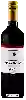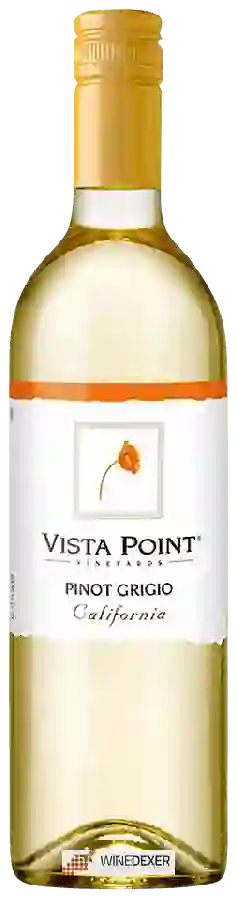
Winery Vista PointPinot Grigio
 White wine



In the mouth this white wine is a .
This wine generally goes well with pork, cured meat or mushrooms.
Taste structure of the Pinot Grigio from the Winery Vista Point
Light | Bold | |
Dry | Sweet | |
Soft | Acidic |
In the mouth the Pinot Grigio of Winery Vista Point in the region of California is a .
Wine flavors and olphactive analysis

On the nose the Pinot Grigio of Winery Vista Point in the region of California often reveals types of flavors of tree fruit, citrus fruit or tropical fruit.
Food and wine pairings with Pinot Grigio
Pairings that work perfectly with Pinot Grigio



Original food and wine pairings with Pinot Grigio

The Pinot Grigio of Winery Vista Point matches generally quite well with dishes of pork, spicy food or mushrooms such as recipes of cassoulet of yesteryear, jambalaya (louisiana) or white lamb kidneys with parsley cream.
Details and technical informations about Winery Vista Point's Pinot Grigio.
Discover the grape variety: Seinoir
Seinoir noir is a grape variety that originated in . This grape variety is the result of a cross between the same species (interspecific hybridization). It produces a variety of grape specially used for wine making. It is rare to find this grape to eat on our tables. The Seinoir noir can be found cultivated in the following vineyards: Provence & Corsica, Rhône Valley, Loire Valley, Savoie & Bugey, Beaujolais.
Last vintages of this wine
The best vintages of Pinot Grigio from Winery Vista Point are 0, 2008
Informations about the Winery Vista Point
The Winery Vista Point is one of of the world's greatest estates. It offers 6 wines for sale in the of California to come and discover on site or to buy online.

The wine region of California
California is the largest and most important wine region in the United States. It represents the southern two-thirds (850 miles or 1,370 kilometers) of the country's west coast. (Oregon and Washington make up the rest. ) The state also spans nearly 10 degrees of latitude.
The word of the wine: Grafting
A method used since the phylloxera crisis, consisting of fixing a graft of local origin on a rootstock resistant to phylloxera.