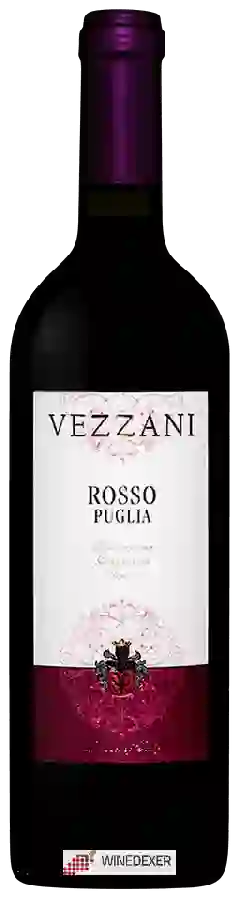
Winery VezzaniRosso
 Red wine


In the mouth this red wine is a powerful.
This wine generally goes well with beef, lamb or pasta.

Taste structure of the Rosso from the Winery Vezzani
Light | Bold | |
Smooth | Tannic | |
Dry | Sweet | |
Soft | Acidic |
In the mouth the Rosso of Winery Vezzani in the region of Puglia is a powerful.
Wine flavors and olphactive analysis


On the nose the Rosso of Winery Vezzani in the region of Puglia often reveals types of flavors of microbio, spices or red fruit.
Food and wine pairings with Rosso
Pairings that work perfectly with Rosso



Original food and wine pairings with Rosso
The Rosso of Winery Vezzani matches generally quite well with dishes of beef, pasta or lamb such as recipes of braised beef with carrots, pasta "carbonara" à la française or lamb meatballs with mint.
Details and technical informations about Winery Vezzani's Rosso.
Discover the grape variety: Muscat Bailey A
Supple, fruity reds with a moderate ruby robe, silky tannins and a direct palate, with signature Muscat aromas (fresh grape, rose), red fruits (cherry, strawberry), candy and hybrid herbal notes. A simple, early-ripening profile. Widely grown in Japan (Yamanashi, Nagano), it is the emblem of modern Japanese reds. Black hybrid grape created in 1927 by Zenbei Kawakami, a Bailey × Muscat Hamburg cross.
Last vintages of this wine
The best vintages of Rosso from Winery Vezzani are 2015, 2014, 2018, 2016 and 2013.
Informations about the Winery Vezzani
The Winery Vezzani is one of of the world's greatest estates. It offers 23 wines for sale in the of Puglia to come and discover on site or to buy online.

The wine region of Puglia
Heel of the boot, 80% red vineyard, sunny and generous. Fleshy, jammy Primitivo (= Zinfandel) with notes of black cherry, plum, chocolate and spices, powerful alcohol and melted tannins, a star in Primitivo di Manduria. Deep, structured Negroamaro (black-bitter) with a bitter finish in Salice Salentino. Structured Nero di Troia, spicy Susumaniello.
The word of the wine: Grenache gris
A grey variety of Grenache grown in the Pyrénées-Orientales, the Aude and the southern Rhône valley. Its powerful and round wines are used in the blending of dry white or rosé wines and natural sweet wines.