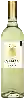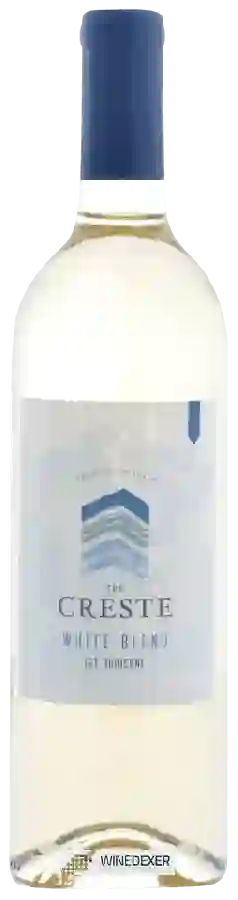
Winery Tre CresteWhite Blend
 White wine
In the mouth this white wine is a powerful.
This wine generally goes well with lean fish, shellfish or mature and hard cheese.

Taste structure of the White Blend from the Winery Tre Creste
Light | Bold | |
Dry | Sweet | |
Soft | Acidic |
In the mouth the White Blend of Winery Tre Creste in the region of Emilia-Romagna is a powerful.
Food and wine pairings with White Blend
Pairings that work perfectly with White Blend



Original food and wine pairings with White Blend


The White Blend of Winery Tre Creste matches generally quite well with dishes of pasta, shellfish or mature and hard cheese such as recipes of trofie ( pasta ) paradiso, stuffed squid or penne with chicken, mushrooms and comté.
Details and technical informations about Winery Tre Creste's White Blend.
Discover the grape variety: Siria
Fresh and aromatic whites to drink young, with a pale golden hue, an airy palate with preserved acidity and signature aromas of citrus (lemon, grapefruit), green apple, white flowers and fresh herbal notes. Used in many Portuguese white blends, grown in the Dão DOC, Beira Interior DOC and Douro DOC. Autochthonous white Portuguese variety, one of the most planted in Portugal, also known as Roupeiro and Códega.
Informations about the Winery Tre Creste
The Winery Tre Creste is one of of the world's greatest estates. It offers 6 wines for sale in the of Rubicone to come and discover on site or to buy online.

The wine region of Rubicone
Vast Emilia-Romagna IGT (Forli-Cesena, Ravenna, Rimini): signature Sangiovese as accessible king red — robust and fruity with notes of ripe red fruit (cherry, plum), violet, liquorice and a touch of spice, round tannins and a gourmet finish. Lively Barbera as complement. Trebbiano (Romagnolo and Toscano) as king white — fresh and light with notes of green apple, white flowers and citrus, tonic acidity. Pinot Bianco as complement.
The wine region of Emilia-Romagna
Kingdom of Lambrusco: fresh, fruity sparkling reds (blackberry, cherry, violet), from gourmet dry to convivial off-dry, perfect with local charcuterie. World's best-selling sparkling wine on the Emilia side (Sorbara, Grasparossa, Salamino). East, Romagna: supple fruity Sangiovese, Albana (Italy's 1st white DOCG, 1987) ample and almondy. Also red Gutturnio and white Pignoletto.
The word of the wine: Oenophile
A person who is interested in the world of wine and more particularly in wine tasting.