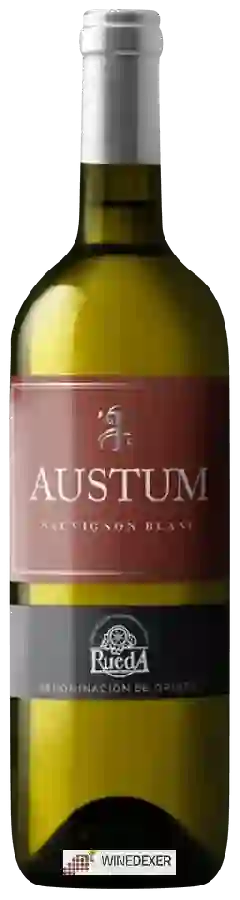
Bodegas TionioAustum Sauvignon Blanc
 White wine



In the mouth this white wine is a powerful with a nice freshness.
This wine generally goes well with vegetarian, shellfish or goat cheese.
Taste structure of the Austum Sauvignon Blanc from the Bodegas Tionio
Light | Bold | |
Dry | Sweet | |
Soft | Acidic |
In the mouth the Austum Sauvignon Blanc of Bodegas Tionio in the region of Castille-et-Léon is a powerful with a nice freshness.
Food and wine pairings with Austum Sauvignon Blanc
Pairings that work perfectly with Austum Sauvignon Blanc



Original food and wine pairings with Austum Sauvignon Blanc
The Austum Sauvignon Blanc of Bodegas Tionio matches generally quite well with dishes of shellfish, vegetarian or goat cheese such as recipes of spaghetti with shrimp and cream, spinach and goat cheese quiche or leek and fresh goat cheese quiche.
Details and technical informations about Bodegas Tionio's Austum Sauvignon Blanc.
Discover the grape variety: Scheurebe
German grape variety obtained in 1916 by Georg Shere (1879/1949). It was given until then as coming from a cross between Riesling and Sylvaner, but genetic tests have shown that its father is the Bouquettraube (Bukettrebe), and it is closely related to the Kerner. The Scheurebe can be found in Austria, Germany, Belgium, Switzerland, the Netherlands, Italy, Slovenia, Great Britain, the United States (California, Virginia, ...), Canada (Ontario, British Columbia, ...), ... practically unknown in France.
Last vintages of this wine
The best vintages of Austum Sauvignon Blanc from Bodegas Tionio are 2019, 0
Informations about the Bodegas Tionio
The Bodegas Tionio is one of of the world's greatest estates. It offers 7 wines for sale in the of Rueda to come and discover on site or to buy online.

The wine region of Rueda
The wine region of Rueda is located in the region of Castille-et-Léon of Spain. Wineries and vineyards like the Domaine Belondrade or the Domaine Ordóñez produce mainly wines white, sweet and red. The most planted grape varieties in the region of Rueda are Verdejo, Tempranillo and Albarino, they are then used in wines in blends or as a single variety. On the nose of Rueda often reveals types of flavors of grapefruit, balsamic or sage and sometimes also flavors of chalk, mint or tomatoes.
The wine region of Castille-et-Léon
Located in the northern half of the Central Iberian plateau, Castilla y León is the largest of Spain's 17 administrative regions, covering about one-fifth of the country's total area. It extends about 350 kilometres (220 miles) from central Spain to the northern coast. Just as wide, it connects the Rioja wine region to the Portuguese border. Red wines reign supreme in Castilla y León, and the Tempranillo grape is undoubtedly the king.
The word of the wine: Reduction
A physiological and chemical phenomenon that occurs in wine in the absence of oxygen. The smell of reduction is characterized by animal and sometimes fetid notes that disappear in principle with aeration. It is recommended to decant reduced wines.