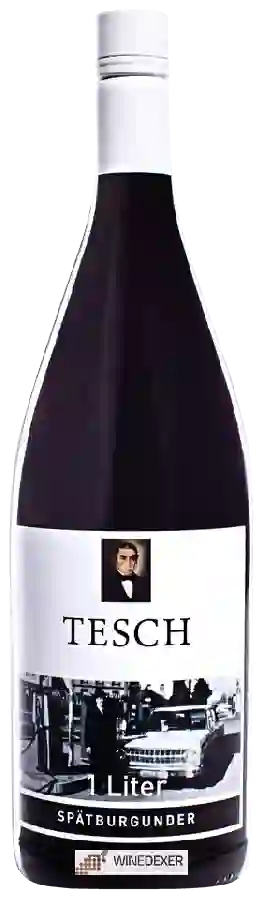
Winery Martin TeschSpätburgunder
 Red wine


In the mouth this red wine is a with a nice freshness.
This wine generally goes well with poultry, beef or veal.

Taste structure of the Spätburgunder from the Winery Martin Tesch
Light | Bold | |
Smooth | Tannic | |
Dry | Sweet | |
Soft | Acidic |
In the mouth the Spätburgunder of Winery Martin Tesch in the region of Nahe is a with a nice freshness.
Wine flavors and olphactive analysis


On the nose the Spätburgunder of Winery Martin Tesch in the region of Nahe often reveals types of flavors of red fruit.
Food and wine pairings with Spätburgunder
Pairings that work perfectly with Spätburgunder



Original food and wine pairings with Spätburgunder

The Spätburgunder of Winery Martin Tesch matches generally quite well with dishes of beef, veal or game (deer, venison) such as recipes of beef bobotie, chicken supreme with morels or rabbit legs with mushrooms.
Details and technical informations about Winery Martin Tesch's Spätburgunder.
Discover the grape variety: Aubun
Supple, alcoholic reds with a light ruby colour, soft tannins and a broad palate with moderate acidity, showing understated aromas of red and dark fruits with garrigue notes. Late ripening, vigorous and productive. Found in southern blends of Côtes-du-Rhône AOC and local IGPs, grown in Vaucluse, Gard, Var and Ardèche. Native Provençal black variety, probably originating from Vaucluse.
Last vintages of this wine

The best vintages of Spätburgunder from Winery Martin Tesch are 2014, 2017, 0, 2016 and 2015.
Informations about the Winery Martin Tesch
The Winery Martin Tesch is one of of the world's great estates. It offers 44 wines for sale in the of Nahe to come and discover on site or to buy online.

The wine region of Nahe
Homeland of a mineral Riesling of exceptional geological expression: lively, precise whites with notes of peach, citrus, green apple, gunflint and fine salinity, from taut dry to botrytised sweet. 75% whites, Riesling king (27%) complemented by round Pinot Gris and supple Pinot Blanc. Rising reds: silky Spätburgunder with red fruit, darker Dornfelder. 4,240 ha along the Nahe river, among the most diverse soils in Germany (180 formations).
The word of the wine: Tartar (deposit)
White, chalky deposits that occur as a result of precipitation inside bottles and are often considered by consumers as a defect. They are in fact tartaric salts formed by tartaric acid, potassium and calcium naturally present in the wine. This deposit does not alter the quality of the wine and can be eliminated by a simple decanting.