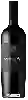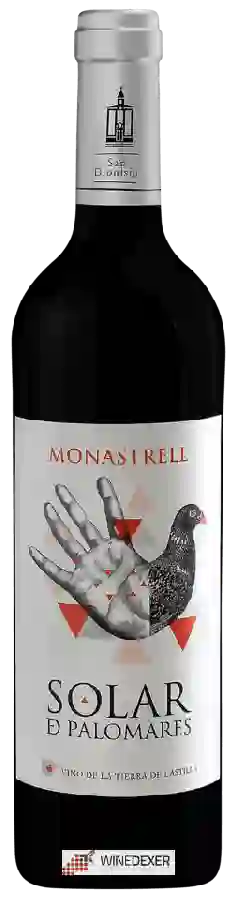
Winery Solar de PalomaresMonastrell
 Red wine


In the mouth this red wine is a powerful with a nice balance between acidity and tannins.
This wine generally goes well with beef, game (deer, venison) or lamb.
Taste structure of the Monastrell from the Winery Solar de Palomares
Light | Bold | |
Smooth | Tannic | |
Dry | Sweet | |
Soft | Acidic |
In the mouth the Monastrell of Winery Solar de Palomares in the region of Castille is a powerful with a nice balance between acidity and tannins.
Food and wine pairings with Monastrell
Pairings that work perfectly with Monastrell



Original food and wine pairings with Monastrell

The Monastrell of Winery Solar de Palomares matches generally quite well with dishes of beef, pasta or lamb such as recipes of roast pork with pineapple, tunisian pasta or lamb tagine with dried fruits.
Details and technical informations about Winery Solar de Palomares's Monastrell.
Discover the grape variety: Solaris
Interspecific cross between merzling x Geisenheim 6493 (zarya severa x muscat ottonel) obtained in Germany in 1975 by Norbert Becker. It has the particularity of having only one gene for resistance to mildew and powdery mildew. It can be found in Germany, Belgium, Italy, Switzerland, the Netherlands, Denmark, England, etc. In France, it is still little known.
Last vintages of this wine
The best vintages of Monastrell from Winery Solar de Palomares are 0, 2015
Informations about the Winery Solar de Palomares
The Winery Solar de Palomares is one of of the world's greatest estates. It offers 4 wines for sale in the of Castille to come and discover on site or to buy online.

The wine region of Castille
Castilla-La Mancha is a large region located South and east of the Spanish capital, Madrid. Inexpensive table wines are produced from a variety of Grapes. Higher quality wines are increasingly available, but the region is traditionally known as a source of low quality bulk wine. More than half of Spain's grapes are grown here.
The word of the wine: Rebêche (champagne)
Must obtained in excess of the 2 550 litres authorised for a weight of 4 000 kilos of grapes. The first 2 050 litres constitute the cuvée and the next 500 litres the taille. The rebêche represents 1 to 3 % of the total volume and must be distilled or used to make ratafia.