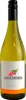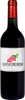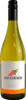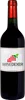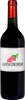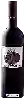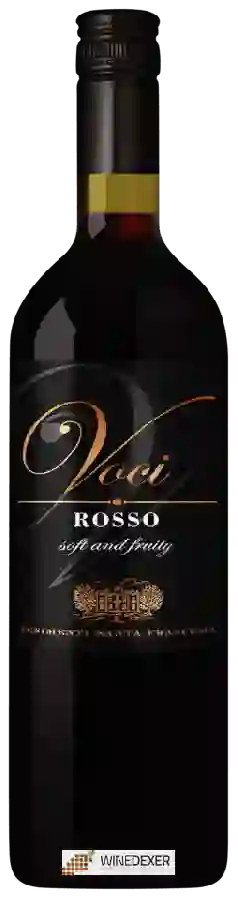
Winery Tenimenti Santa FrancescaVoci Rosso
 Red wine


In the mouth this red wine is a powerful.
This wine generally goes well with poultry, beef or veal.

Taste structure of the Voci Rosso from the Winery Tenimenti Santa Francesca
Light | Bold | |
Smooth | Tannic | |
Dry | Sweet | |
Soft | Acidic |
In the mouth the Voci Rosso of Winery Tenimenti Santa Francesca in the region of Umbria is a powerful.
Food and wine pairings with Voci Rosso
Pairings that work perfectly with Voci Rosso



Original food and wine pairings with Voci Rosso

The Voci Rosso of Winery Tenimenti Santa Francesca matches generally quite well with dishes of beef, pasta or veal such as recipes of blanquette of monkfish with small vegetables, salmon lasagna or duck breast with orange sauce.
Details and technical informations about Winery Tenimenti Santa Francesca's Voci Rosso.
Discover the grape variety: Pinot noir
Elegant reds, light in colour with silky tannins, showing strawberry, cherry and raspberry aromas, evolving to forest floor, mushroom and spice with age. Fresh acidity, delicate finish. Star of the Côte d'Or (Romanée-Conti, Chambertin, Volnay), pillar of Champagne (Blanc de Noirs) and signature of Oregon, Central Otago and Sonoma Coast. An early-ripening Burgundian variety, one of the world's greatest.
Last vintages of this wine
The best vintages of Voci Rosso from Winery Tenimenti Santa Francesca are 2016, 0
Informations about the Winery Tenimenti Santa Francesca
The Winery Tenimenti Santa Francesca is one of of the world's great estates. It offers 36 wines for sale in the of Umbria to come and discover on site or to buy online.

The wine region of Umbria
"Green heart" of Italy, cradle of Sagrantino: exceptional tannic red in Sagrantino di Montefalco DOCG, dense and concentrated with notes of blackberry, candied plum, liquorice, spice and leather, powerful tannins and long ageing. Suppler Sangiovese in blends, Cabernet and Merlot in Torgiano DOCG. Orvieto whites based on Grechetto and Trebbiano, full and almondy, from dry to sweet Muffato. ~13,000 ha between Tuscany and Lazio.
The word of the wine: Terroir
Strictly speaking, the notion of terroir corresponds to the geological characteristics of a vineyard. However, when we talk about terroir, we take into account the soil, the climate (even the microclimate), the flora, the fauna, and the human factor that characterizes the practices that make up the art of the craft.