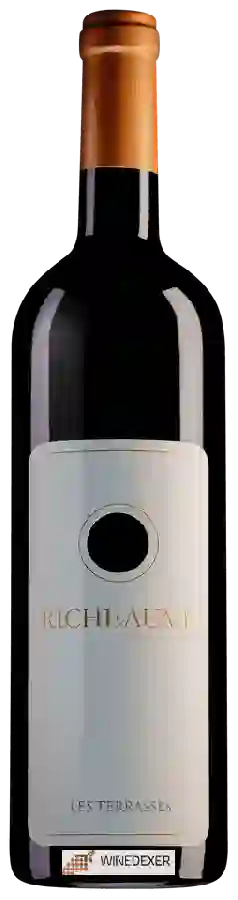
Winery RicheaumeLes Terrasses
 Red wine


This wine generally goes well with beef, lamb or mature and hard cheese.
The Les Terrasses of the Winery Richeaume is in the top 40 of wines of Provence.

Wine flavors and olphactive analysis

Food and wine pairings with Les Terrasses
Pairings that work perfectly with Les Terrasses



Original food and wine pairings with Les Terrasses

The Les Terrasses of Winery Richeaume matches generally quite well with dishes of beef, lamb or spicy food such as recipes of braised beef with carrots, leg of lamb in braillouse or pasta with broccoli.
Details and technical informations about Winery Richeaume's Les Terrasses.
Discover the grape variety: Iona
Simple, aromatic whites with a pale golden robe, a supple palate with preserved acidity. Characteristic foxy aromas of Vitis labrusca (wild strawberry, wild raspberry). Early ripening, cold-hardy. Grown in the north-eastern United States and Canada (Ontario) for simple wines, local sparkling wines and fresh consumption. An American white hybrid derived from Vitis labrusca, discovered around 1855 in New York State.
Last vintages of this wine

The best vintages of Les Terrasses from Winery Richeaume are 2015, 2011, 2012, 2010 and 2004.
Informations about the Winery Richeaume
The Winery Richeaume is one of of the world's greatest estates. It offers 15 wines for sale in the of Provence to come and discover on site or to buy online.

The wine region of Provence
World capital of dry, refined rosé (~90% of production). Pale rose-petal colour, delicate nose of fresh red fruits (strawberry, raspberry, redcurrant), citrus (pink grapefruit), white flowers and a mineral touch, taut and thirst-quenching palate — the Mediterranean aperitif par excellence. Blends of Grenache, Cinsault, Syrah, Tibouren and Mourvèdre. Fleshy Bandol reds from Mourvèdre (leather, garrigue, age-worthy), straight Cassis whites.
The word of the wine: Picpoul
See piquepoul.