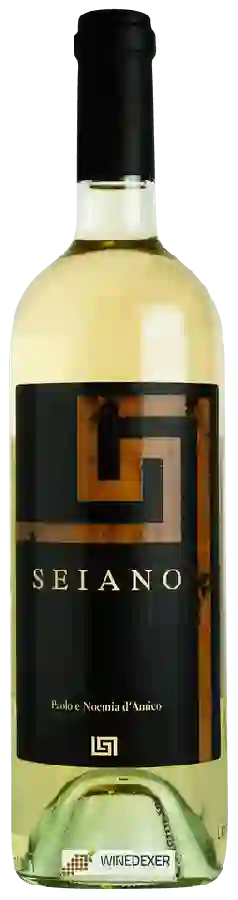
Winery Paolo e Noemia d'AmicoSeiano Bianco
 White wine


In the mouth this white wine is a with a nice freshness.
This wine generally goes well with vegetarian, appetizers and snacks or lean fish.
Taste structure of the Seiano Bianco from the Winery Paolo e Noemia d'Amico
Light | Bold | |
Dry | Sweet | |
Soft | Acidic |
In the mouth the Seiano Bianco of Winery Paolo e Noemia d'Amico in the region of Umbria is a with a nice freshness.
Wine flavors and olphactive analysis



On the nose the Seiano Bianco of Winery Paolo e Noemia d'Amico in the region of Umbria often reveals types of flavors of earth, tree fruit or citrus fruit and sometimes also flavors of tropical fruit.
Food and wine pairings with Seiano Bianco
Pairings that work perfectly with Seiano Bianco



Original food and wine pairings with Seiano Bianco


The Seiano Bianco of Winery Paolo e Noemia d'Amico matches generally quite well with dishes of pasta, vegetarian or appetizers and snacks such as recipes of pad thai, light tuna-tomato quiche (without cream) or lupine seeds for kemia (the aperitif).
Details and technical informations about Winery Paolo e Noemia d'Amico's Seiano Bianco.
Discover the grape variety: Lakemont
Interspecific cross between ontario (winchell x diamond) and sultana made in 1972 by John Einset (1915/1981) at the New York State Agricultural Experimental Station (United States). It is certainly known in the United States but also in Canada, in many European wine-producing countries including Germany and England where it is cultivated under greenhouses and tunnels, most often cold, ... little multiplied and therefore little known in France except by amateur gardeners. The interlaken which looks a little like the himrod, the himrod and the romulus have the same parents.
Last vintages of this wine

The best vintages of Seiano Bianco from Winery Paolo e Noemia d'Amico are 2016, 2017, 2012, 0 and 2014.
Informations about the Winery Paolo e Noemia d'Amico
The Winery Paolo e Noemia d'Amico is one of of the world's greatest estates. It offers 14 wines for sale in the of Umbria to come and discover on site or to buy online.

The wine region of Umbria
Umbria, in CentralItaly, is a region of lush hills, hilltop villages and iconic historic towns. The latter are exemplified by Orvieto and Assisi. At the very heart of the Italian peninsula, it is surrounded by Tuscany, Marche and Lazio. It is in fact the only Italian region without a coastline or international border.
The word of the wine: Classified growth
Place name or castle subject to a classification (Médoc classification of 1855, classified growths of Alsace...)