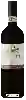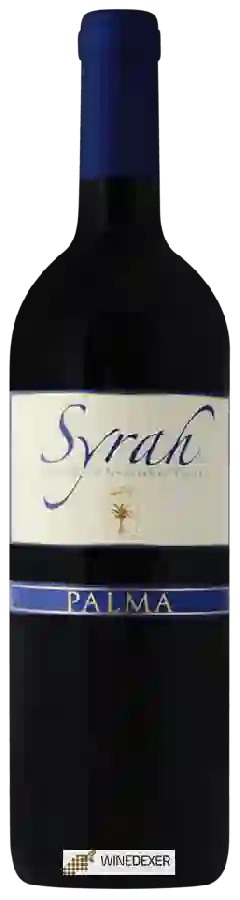
Winery PalmaSyrah
 Red wine



In the mouth this red wine is a powerful with a nice balance between acidity and tannins.
This wine generally goes well with poultry, beef or veal.
Taste structure of the Syrah from the Winery Palma
Light | Bold | |
Smooth | Tannic | |
Dry | Sweet | |
Soft | Acidic |
In the mouth the Syrah of Winery Palma in the region of Tuscany is a powerful with a nice balance between acidity and tannins.
Wine flavors and olphactive analysis


On the nose the Syrah of Winery Palma in the region of Tuscany often reveals types of flavors of oak.
Food and wine pairings with Syrah
Pairings that work perfectly with Syrah



Original food and wine pairings with Syrah


The Syrah of Winery Palma matches generally quite well with dishes of beef, lamb or veal such as recipes of wild boar stew in burgundy style, rack of lamb with herbs or oven-baked veal cutlets.
Details and technical informations about Winery Palma's Syrah.
Discover the grape variety: Prior
Interspecific cross between Freiburg 4-61 (23-416 Joannès-Seyve x pinot noir) and Bronner made in 1987 by Norbert Becker of the Freiburg Research Institute in Germany. It has the particularity of having only one gene for resistance to mildew and powdery mildew. It can be found in Germany, but also in Switzerland, Belgium, ... and in France.
Last vintages of this wine
The best vintages of Syrah from Winery Palma are 2015, 0, 2013, 2014
Informations about the Winery Palma
The Winery Palma is one of of the world's greatest estates. It offers 10 wines for sale in the of Tuscany to come and discover on site or to buy online.

The wine region of Tuscany
Tuscany is one of the most famous and prolific wine regions in Europe. It is best known for its Dry red wines made from Sangiovese grapes, which dominate production. These include Chianti, Brunello di Montalcino and Vino Nobile di Montepulciano. The region's Vin Santo is also highly prized, as are its passito dessert wines, though these are produced in comparatively tiny quantities.
The word of the wine: Ovoids (tanks)
Egg-shaped vats used for wine making and maturing that favour the natural suspension of the lees thanks to the vortex movements, which give the wine more fat and fruity aromas.