The Morgenster Estate of Stellenbosch of Western Cape
Morgenster Estate
The winery offers 20 different wines
4.1


Note - 1Note - 1Note - 1Note - 1Note - 0
Its wines get an average rating of 4.1.
It is ranked in the top 73 of the estates of Western Cape.
It is located in Stellenbosch in the region of Western Cape

The Morgenster Estate is one of the world's great estates. It offers 20 wines for sale in of Stellenbosch to come and discover on site or to buy online.


Top Morgenster Estate wines

Looking for the best Morgenster Estate wines in Stellenbosch among all the wines in the region? Check out our tops of the best red, white or effervescent Morgenster Estate wines. Also find some food and wine pairings that may be suitable with the wines from this area. Learn more about the region and the Morgenster Estate wines with technical and enological descriptions.

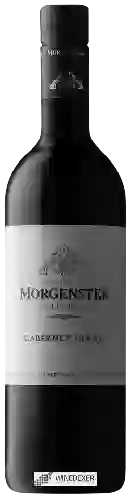
The top red wines of Morgenster Estate

Food and wine pairings with a red wine of Morgenster Estate

How Morgenster Estate wines pair with each other generally quite well with dishes of beef, lamb or game (deer, venison) such as recipes of beef strogonoff, seven o'clock leg of lamb or duck breast with orange sauce.

Organoleptic analysis of red wines of Morgenster Estate

On the nose the red wine of Morgenster Estate. often reveals types of flavors of non oak, earth or microbio and sometimes also flavors of vegetal, oak or tree fruit. In the mouth the red wine of Morgenster Estate. is a powerful with a nice balance between acidity and tannins.

The best vintages in the red wines of Morgenster Estate

  • 2003With an average score of 4.30/5
  • 2000With an average score of 4.30/5
  • 2006With an average score of 4.23/5
  • 2004With an average score of 4.21/5
  • 2002With an average score of 4.20/5
  • 2008With an average score of 4.20/5

The grape varieties most used in the red wines of Morgenster Estate.

  • Merlot
  • Cabernet Sauvignon
  • Cabernet Franc
  • Sangiovese
  • Nebbiolo
  • Petit Verdot

Discovering the wine region of Stellenbosch

Showcase of the South African vineyard: signature Cabernet Sauvignon as king red — structured and age-worthy with notes of blackcurrant, blackberry, cedar, tobacco and a menthol touch, firm tannins. Emblematic national Pinotage (created 1925) opulent and smoky (blackberry, coffee, leather). Fleshy Shiraz, supple Merlot as complement. Vibrant Chenin Blanc, ample Chardonnay and lively Sauvignon in whites.

Western Cape district (1679), Mediterranean climate tempered by False Bay, granitic soils.

The top sparkling wines of Morgenster Estate

Food and wine pairings with a sparkling wine of Morgenster Estate

How Morgenster Estate wines pair with each other generally quite well with dishes of beef, pork or game (deer, venison) such as recipes of venison stew with red wine, pork roulades with cream and mushrooms or mymy's golden apples (squash).

Organoleptic analysis of sparkling wines of Morgenster Estate

On the nose the sparkling wine of Morgenster Estate. often reveals types of flavors of tree fruit.

The best vintages in the sparkling wines of Morgenster Estate

  • 2016With an average score of 3.80/5
  • 0With an average score of 3.80/5

The grape varieties most used in the sparkling wines of Morgenster Estate.

  • Cabernet Franc

Discover the grape variety: Vermentino

The vermentino grape variety was widespread in Italy, Sardinia and Corsica. Today, Vermentino is grown in the regions bordering the Mediterranean, mainly in Provence (Côtes de Provence, Bellet), Corsica (Corse Calvi), Languedoc (Côtes du Roussillon, Costières de Nîmes) and the Rhône Valley (Côtes du Luberon). Because it ripens late, Vermentino requires a warm climate for its development and can only be grown in regions with good sun exposure. Conversely, cold or temperate climates do not allow it to ripen properly. Vermentino is only susceptible to powdery mildew. When vinified on its own, Vermentino produces a single-variety dry white wine that is light and full-bodied with a pale yellow color. It can also be blended with other grape varieties such as Ugni Blanc, Cinsault and Grenache, in which case its low acidity makes it light and fresh. Vermentino belongs to the grape varieties of Ajaccio, Corsica and Corbières. The aromas released by this variety are multiple. One can detect notes of fresh apple, green almond, sweet spices, hawthorn, ripe pear and fresh pineapple.

The top pink wines of Morgenster Estate

Food and wine pairings with a pink wine of Morgenster Estate

How Morgenster Estate wines pair with each other generally quite well with dishes of beef, veal or pork such as recipes of beef tongue with mushrooms, veal cutlets with cream sauce or meatloaf with lovage (perpetual celery).

Organoleptic analysis of pink wines of Morgenster Estate

On the nose the pink wine of Morgenster Estate. often reveals types of flavors of earth, microbio or vegetal and sometimes also flavors of oak, spices or red fruit.

The best vintages in the pink wines of Morgenster Estate

  • 2010With an average score of 4.40/5
  • 2016With an average score of 3.70/5
  • 2015With an average score of 3.70/5
  • 2013With an average score of 3.70/5
  • 0With an average score of 3.70/5
  • 2014With an average score of 3.60/5

The grape varieties most used in the pink wines of Morgenster Estate.

  • Sangiovese

The word of the wine: Muscat blanc à petits grains

A white grape variety cultivated since antiquity on the shores of the Mediterranean, it is considered the noblest of the muscats. It is mainly used to make sweet wines, often from mutage. In France, it is the sole variety used in many natural sweet wines: muscat-de-frontignan, muscat-de-mireval, muscat-de-lunel, muscat-de-saint-jean-de-minervois, muscat-de-beaumes-de-venise, muscat-du-cap-corse. Combined with Muscat d'Alexandrie, it gives Muscat-de-Rivesaltes. It is also used to make sparkling white wines (clairette-de-die; moscato d'asti and asti spumante in Italy) and dry wines (alsace-muscat). Powerfully aromatic and complex, its wines evoke fresh grapes, roses, exotic fruits, citrus fruits and spices.

The top white wines of Morgenster Estate

Food and wine pairings with a white wine of Morgenster Estate

How Morgenster Estate wines pair with each other generally quite well with dishes of shellfish, vegetarian or goat cheese such as recipes of shrimp in coconut milk curry, zucchini quiche or pan-fried ham, goat cheese and onion.

Organoleptic analysis of white wines of Morgenster Estate

On the nose the white wine of Morgenster Estate. often reveals types of flavors of tropical fruit, non oak or earth and sometimes also flavors of microbio, vegetal or tree fruit. In the mouth the white wine of Morgenster Estate. is a with a nice freshness.

The best vintages in the white wines of Morgenster Estate

  • 2013With an average score of 4.00/5
  • 2018With an average score of 3.79/5
  • 2020With an average score of 3.72/5
  • 2015With an average score of 3.69/5
  • 2019With an average score of 3.68/5
  • 0With an average score of 3.67/5

The grape varieties most used in the white wines of Morgenster Estate.

  • Sauvignon Blanc
  • Vermentino
  • Sémillon

Discover the grape variety: Sauvignon blanc

Originally from Bordeaux, Sauvignon, or Sauvignon Blanc, is reputed to be one of the best French grape varieties for white wine. It is a white grape variety, not to be confused with Sauvignon Gris and its pale yellow color, or with Cabernet Sauvignon which produces red wines. Particularly famous thanks to Sancerre, Sauvignon Blanc is cultivated as far as New Zealand, where it produces great wines whose reputation is well established.

Discover other wineries and winemakers neighboring the Morgenster Estate

Planning a wine route in the of Stellenbosch? Here are the wineries to visit and the winemakers to meet during your trip in search of wines similar to Morgenster Estate.

Discover the grape variety: Merlot

Merlot is a red grape variety with small black berries that appeared at the end of the 18th century. It is produced in most of the Bordeaux terroirs, where it represents 58% of the planted area, and its best terroir is located in Pomerol and Saint-Emilion on cool, clay-limestone soils. At the mythical Château Pétrus, the wine is made with 95% Merlot, with a dark, dense colour, aromas of red and black fruits and a superb range of flavours, the Merlot transforms during its ageing to give way to notes of prunes, undergrowth and spices. On the palate, it is supple with distinguished tannins. It is often blended with Cabernet Sauvignon. Merlot is no longer exclusive to Bordeaux, it is nowadays vinified all over the world.