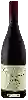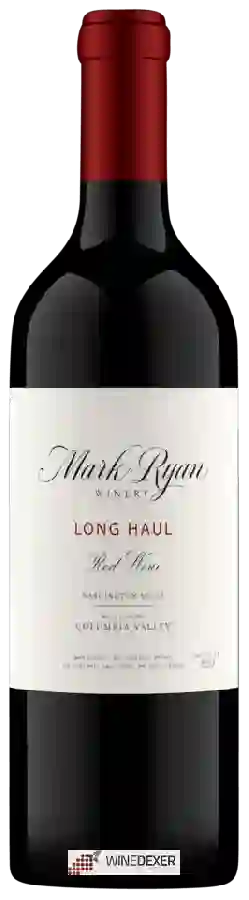
Mark Ryan WineryLong Haul
 Red wine


This wine is a blend of 4 varietals which are the Cabernet franc, the Cabernet-Sauvignon, the Petit Verdot and the Merlot.
In the mouth this red wine is a powerful with a nice balance between acidity and tannins.
This wine generally goes well with poultry, beef or veal.
The Long Haul of the Mark Ryan Winery is in the top 90 of wines of Columbia Valley.
Taste structure of the Long Haul from the Mark Ryan Winery
Light | Bold | |
Smooth | Tannic | |
Dry | Sweet | |
Soft | Acidic |
In the mouth the Long Haul of Mark Ryan Winery in the region of Washington is a powerful with a nice balance between acidity and tannins.
Wine flavors and olphactive analysis






On the nose the Long Haul of Mark Ryan Winery in the region of Washington often reveals types of flavors of non oak, earth or microbio and sometimes also flavors of vegetal, oak or spices.
Food and wine pairings with Long Haul
Pairings that work perfectly with Long Haul



Original food and wine pairings with Long Haul

The Long Haul of Mark Ryan Winery matches generally quite well with dishes of beef, pasta or veal such as recipes of family potluck, pasta with goat cheese, thyme and bacon or sarthe pot.
Details and technical informations about Mark Ryan Winery's Long Haul.
Discover the grape variety: Cabernet franc
Cabernet Franc is one of the oldest red grape varieties in Bordeaux. The Libourne region is its terroir where it develops best. The terroirs of Saint-Emilion and Fronsac allow it to mature and develop its best range of aromas. It is also the majority in many blends. The very famous Château Cheval Blanc, for example, uses 60% Cabernet Franc. The wines produced with Cabernet Franc are medium in colour with fine tannins and subtle aromas of small red fruits and spices. When blended with Merlot and Cabernet Sauvignon, it brings complexity and a bouquet of aromas to the wine. It produces fruity wines that can be drunk quite quickly but whose great vintages can be kept for a long time. It is an earlier grape variety than Cabernet-Sauvignon which means that it is also well planted further north, as far as the Loire Valley. In Anjou, it is also used to make sweet rosé wines. Cabernet Franc is now used in some twenty countries in Europe and throughout the world.
Last vintages of this wine
The best vintages of Long Haul from Mark Ryan Winery are 2008, 2015, 2011, 2009 and 2018.
Informations about the Mark Ryan Winery
The Mark Ryan Winery is one of of the world's greatest estates. It offers 64 wines for sale in the of Columbia Valley to come and discover on site or to buy online.

The wine region of Columbia Valley
The wine region of Columbia Valley is located in the region of Washington of United States. We currently count 841 estates and châteaux in the of Columbia Valley, producing 3147 different wines in conventional, organic and biodynamic agriculture. The wines of Columbia Valley go well with generally quite well with dishes .
The wine region of Washington
Washington State is located in the Pacific Northwest of the United States, immediately north of Oregon. Although the history of the wine industry is relatively Short, Washington's 900-plus wineries and 350-plus independent winemakers, with more than 50,000 acres of vineyards, now produce more wine than any other state except California. Almost all wine production is in the hot, desert-like eastern Part of Washington, although there is some Grape growing and an AVA (Puget Sound) in the cooler, wetter west. White Chardonnay and Riesling grapes, and red Merlot, Cabernet Sauvignon and Syrah grapes are the main varieties grown in Washington, but the region produces quality wines from nearly 70 different grape varieties.
The word of the wine: Powdery mildew
Disease of the vine due to a fungus. Less dreadful than mildew, it only attacks the surface of the green parts. Sulphur has long been the best remedy.