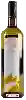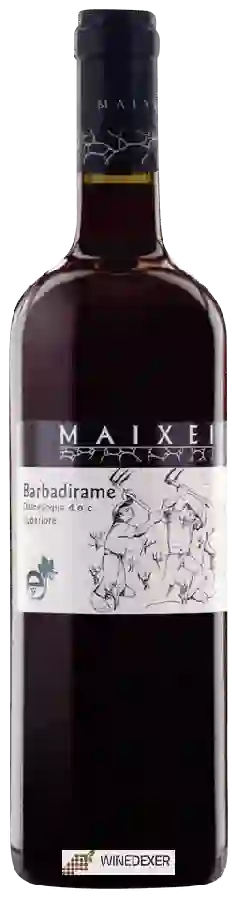
Winery MaixeiBarbadirame Dolceacqua Superiore
 Red wine



In the mouth this red wine is a powerful with a lot of tannins present in the mouth.
This wine generally goes well with beef, game (deer, venison) or lamb.
The Barbadirame Dolceacqua Superiore of the Winery Maixei is in the top 90 of wines of Dolceacqua.

Taste structure of the Barbadirame Dolceacqua Superiore from the Winery Maixei
Light | Bold | |
Smooth | Tannic | |
Dry | Sweet | |
Soft | Acidic |
In the mouth the Barbadirame Dolceacqua Superiore of Winery Maixei in the region of Liguria is a powerful with a lot of tannins present in the mouth.
Wine flavors and olphactive analysis




On the nose the Barbadirame Dolceacqua Superiore of Winery Maixei in the region of Liguria often reveals types of flavors of non oak, earth or oak and sometimes also flavors of spices, red fruit or floral.
Food and wine pairings with Barbadirame Dolceacqua Superiore
Pairings that work perfectly with Barbadirame Dolceacqua Superiore



Original food and wine pairings with Barbadirame Dolceacqua Superiore

The Barbadirame Dolceacqua Superiore of Winery Maixei matches generally quite well with dishes of beef, pasta or lamb such as recipes of beef stew express, pasta and peppers or traditional lamb couscous (from algeria).
Details and technical informations about Winery Maixei's Barbadirame Dolceacqua Superiore.
Discover the grape variety: Albarino
Lively, aromatic whites with sharp acidity and a sleek palate, with intense aromas of citrus, white peach, apricot, white flowers, passion fruit and characteristic Atlantic saline-iodine notes. Tonic and long finish. Absolute star of Rías Baixas DO in Galicia (Spain) and signature of Portuguese Vinho Verde as Alvarinho (Monção e Melgaço). Native Iberian variety, exported to Uruguay, California and New Zealand.
Last vintages of this wine
The best vintages of Barbadirame Dolceacqua Superiore from Winery Maixei are 2012, 2017, 2014, 2013 and 2018.
Informations about the Winery Maixei
The Winery Maixei is one of of the world's greatest estates. It offers 7 wines for sale in the of Dolceacqua to come and discover on site or to buy online.

The wine region of Dolceacqua
First DOC of Liguria (1972) on the Riviera del Ponente near the French border, vineyards on vertiginous terraces (slopes up to 70%, dry-stone walls "maixei"), 300–600 m on schist, Mediterranean climate. Rossese is king (≥95%, known as Rossese di Dolceacqua): fine and perfumed with notes of red cherry, raspberry, wild strawberry, garrigue and a rosy floral touch, silky tannins and radiant fruit — appreciated by Napoleon. Superiore mention. An airy Ligurian gem.
The wine region of Liguria
Coastal region of northwest Italy on the Riviera, terraced vineyards among the steepest in Europe (~1,650 ha). Vermentino signature in white: fresh and saline with signature notes of citrus, white flowers, wild herbs, fresh almond and an iodine mineral touch, taut long mouth. Local Pigato similar and ample, mineral Bosco (min. 40% in Cinque Terre), Albarola.
The word of the wine: Rough
A very astringent and somewhat coarse tannic wine.