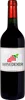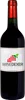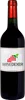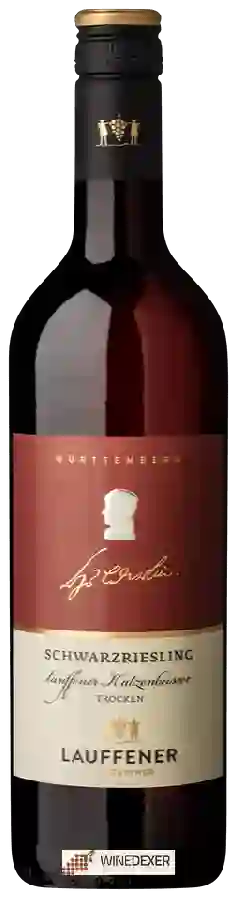
Winery LauffenerKatzenbeisser Schwarzriesling Trocken
 Red wine


This wine generally goes well with pork, poultry or shellfish.
Food and wine pairings with Katzenbeisser Schwarzriesling Trocken
Pairings that work perfectly with Katzenbeisser Schwarzriesling Trocken



Original food and wine pairings with Katzenbeisser Schwarzriesling Trocken


The Katzenbeisser Schwarzriesling Trocken of Winery Lauffener matches generally quite well with dishes of pork, shellfish or spicy food such as recipes of quiche without eggs, waterzooï of the sea or penne à la toscane.
Details and technical informations about Winery Lauffener's Katzenbeisser Schwarzriesling Trocken.
Discover the grape variety: Regent
A complex interspecific cross between the diana (sylvaner x Müller-Thurgau) and the chambourcin obtained in Germany in 1967 by Gerhardt Alleweldt. It can be found in Quebec (Canada), Belgium and Switzerland, but is little known in France. It should be noted that Regent, a monogenic variety, which is nevertheless resistant to certain cryptogamic diseases, was "bypassed" in 2010 by a less resistant strain of mildew, which was also the case for bianca.
Last vintages of this wine

The best vintages of Katzenbeisser Schwarzriesling Trocken from Winery Lauffener are 2018, 2019, 2015, 2014 and 2012.
Informations about the Winery Lauffener
The Winery Lauffener is one of of the world's greatest estates. It offers 92 wines for sale in the of Württemberg to come and discover on site or to buy online.

The wine region of Württemberg
Württemberg is known as Germany's premier red wine region. With almost 11,500 hectares (28,500 acres) of vineyards, it is the fourth-largest wine region in the country. Found adjacent to Baden and South of Franken, Wüttemberg is a particularly hilly and rural wine-region. Almost 70-percent of Württemberg wines are red, predominantly made from Trollinger, SchwarzRiesling and Lemberger.
The word of the wine: Vinification of sweet wines
Moelleux and liquoreux wines are characterized by the presence of residual sugars (natural sugar of the grape), not transformed into alcohol under the effect of yeasts. The fermentation is stopped by cold and by the addition of sulphur dioxide (sulphur).