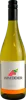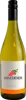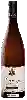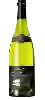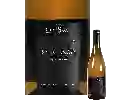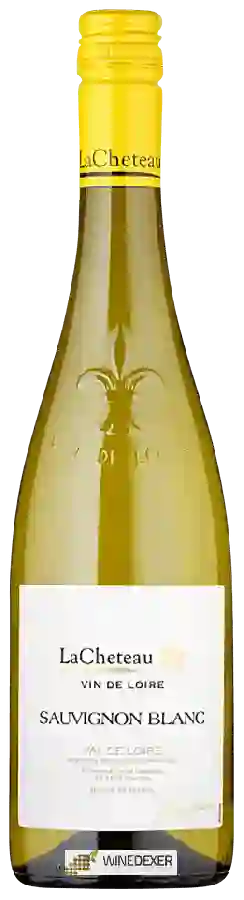
Winery LacheteauSauvignon Blanc
 White wine



This wine generally goes well with vegetarian, rich fish (salmon, tuna etc) or shellfish.
Wine flavors and olphactive analysis


On the nose the Sauvignon Blanc of Winery Lacheteau in the region of Loire Valley often reveals types of flavors of pineapple, citrus or apples and sometimes also flavors of green apple, minerality or lemon.
Food and wine pairings with Sauvignon Blanc
Pairings that work perfectly with Sauvignon Blanc



Original food and wine pairings with Sauvignon Blanc
The Sauvignon Blanc of Winery Lacheteau matches generally quite well with dishes of rich fish (salmon, tuna etc), shellfish or vegetarian such as recipes of salmon in bellevue, mie goreng or zucchini and goat cheese quiche.
Details and technical informations about Winery Lacheteau's Sauvignon Blanc.
Discover the grape variety: Furmint
Furmint is a very old Hungarian grape variety. It arrived in France in the 1800s. The bunches of Furmint are of medium size. They are compact and cylindrical. The berries are also of medium size. They are either short elliptical or rounded. Their thick skin changes from greenish white to reddish once the fruit is mature. This grape variety is known throughout the world for being part of the composition of the Hungarian Tokaj vintage. Robust, rich in alcohol and acidity, it needs light soil and a warm, dry climate to be fertile. It must also be pruned short and its budding takes place 7 days after the Chasselas. As for its maturity, it is of the second late period. This grape variety fears grey rot and erinosis. When vinified dry, Furmint produces a very fragrant, fine and highly alcoholic white wine.
Last vintages of this wine
The best vintages of Sauvignon Blanc from Winery Lacheteau are 2016, 2013, 2019, 2017 and 2018.
Informations about the Winery Lacheteau
The Winery Lacheteau is one of of the world's greatest estates. It offers 84 wines for sale in the of Loire Valley to come and discover on site or to buy online.

The wine region of Loire Valley
The Loire Valley is a key wine region in western France. It follows the course of the Loire River on its Long journey through the heart of France, from the inland hills of the Auvergne to the plains of the French Atlantic coast near Nantes (Muscadet country). Important in terms of quantity and quality, the region produces large quantities (about 4 million h/l each year) of everyday wines, as well as some of France's greatest wines. Diversity is another of the region's major assets; the styles of wine produced here range from the light, tangy Muscadet to the Sweet, honeyed Bonnezeaux, the Sparkling whites of Vouvray and the juicy, Tannic reds of Chinon and Saumur.
The word of the wine: Muscat blanc à petits grains
A white grape variety cultivated since antiquity on the shores of the Mediterranean, it is considered the noblest of the muscats. It is mainly used to make sweet wines, often from mutage. In France, it is the sole variety used in many natural sweet wines: muscat-de-frontignan, muscat-de-mireval, muscat-de-lunel, muscat-de-saint-jean-de-minervois, muscat-de-beaumes-de-venise, muscat-du-cap-corse. Combined with Muscat d'Alexandrie, it gives Muscat-de-Rivesaltes. It is also used to make sparkling white wines (clairette-de-die; moscato d'asti and asti spumante in Italy) and dry wines (alsace-muscat). Powerfully aromatic and complex, its wines evoke fresh grapes, roses, exotic fruits, citrus fruits and spices.