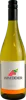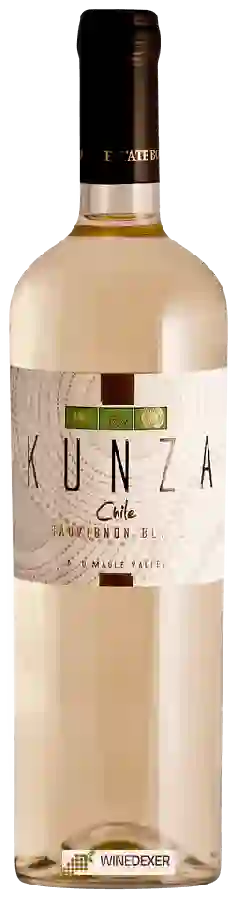
Winery KunzaSauvignon Blanc
 White wine


In the mouth this white wine is a with a nice freshness.
This wine generally goes well with vegetarian, shellfish or goat cheese.
Taste structure of the Sauvignon Blanc from the Winery Kunza
Light | Bold | |
Dry | Sweet | |
Soft | Acidic |
In the mouth the Sauvignon Blanc of Winery Kunza in the region of Central Valley is a with a nice freshness.
Wine flavors and olphactive analysis

On the nose the Sauvignon Blanc of Winery Kunza in the region of Central Valley often reveals types of flavors of citrus fruit.
Food and wine pairings with Sauvignon Blanc
Pairings that work perfectly with Sauvignon Blanc


Original food and wine pairings with Sauvignon Blanc
The Sauvignon Blanc of Winery Kunza matches generally quite well with dishes of shellfish, vegetarian or goat cheese such as recipes of rice with seafood, quiche without eggs or ricotta, goat cheese and zucchini quiche.
Details and technical informations about Winery Kunza's Sauvignon Blanc.
Discover the grape variety: Gouais
It is certainly one of the oldest known grape varieties as it is already reported in the Middle Ages as producing a poor quality wine. Some claim that it has its first origins in eastern France and others in Croatia. It would then have been introduced into France by the Romans, nearly 2,000 years ago. Published genetic analyses have revealed that it is related to several grape varieties, including Saint Côme, Raffiat de Moncade, Muscadelle, Jurançon Blanc, Grease, Colombard, and Mademoiselle Blanche. For more information, click here. Today, the Gouais has practically disappeared from the vineyard, it is still cultivated somewhat in the upper Swiss Valais under the name of Gwäss or Gwaëss.
Last vintages of this wine
The best vintages of Sauvignon Blanc from Winery Kunza are 2016, 2013, 0
Informations about the Winery Kunza
The Winery Kunza is one of of the world's great estates. It offers 11 wines for sale in the of Maule Valley to come and discover on site or to buy online.

The wine region of Maule Valley
Maule Valley is the largest wine-producing region in Chile other than the Central Valley, of which it is a Part. It has 75,000 acres (30,000ha) under Vine, and has traditionally been associated with quantity rather than quality. But this is rapidly changing – the bulk-producing Pais vine is gradually being replaced with more international varieties such as Cabernet Sauvignon and Carmenère, and careful winemaking practices are being employed to make some world-class red wines from old-vine Carignan. The Central Valley itself runs between the Andes and the Coastal Mountains from the Chilean capital of Santiago in the North to the up-and-coming region of Bío Bío in the South.
The wine region of Central Valley
The Central Valley (El Valle Central) of Chile is one of the most important wine-producing areas in South America in terms of Volume. It is also one of the largest wine regions, stretching from the Maipo Valley (just south of Santiago) to the southern end of the Maule Valley. This is a distance of almost 250 miles (400km) and covers a number of Climate types. The Central Valley wine region is easily (and often) confused with the geological Central Valley, which runs north–south for more than 620 miles (1000km) between the Pacific Coastal Ranges and the lower Andes.
The word of the wine: Bitter
Normal for certain young red wines rich in tannin, bitterness is in other cases a defect due to a bacterial disease.