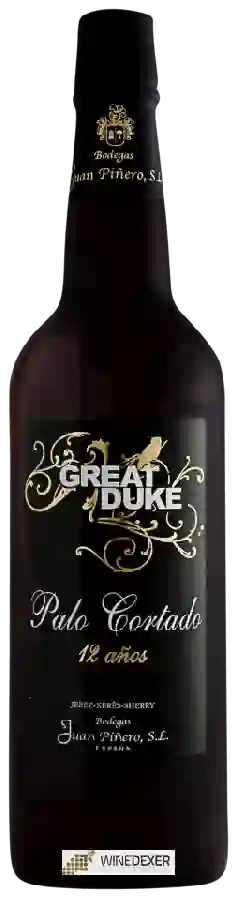
Winery Juan PineroGreat Duke Palo Cortado 12 Años
 Natural sweet wine


This wine generally goes well with
Details and technical informations about Winery Juan Pinero's Great Duke Palo Cortado 12 Años.
Discover the grape variety: Isabelle
It was found in a garden in South Carolina in the United States and given to Isabella Gibbs. It can still be found in Brazil, India, Uruguay, Madagascar, Colombia, Switzerland, Italy, etc. In France, it is one of the six hybrids prohibited since 1935 (included in the European regulations): the Clinton, the Herbemont, the Isabelle, the Jacquez, the Noah and the Othello.
Last vintages of this wine
The best vintages of Great Duke Palo Cortado 12 Años from Winery Juan Pinero are 0
Informations about the Winery Juan Pinero
The Winery Juan Pinero is one of of the world's greatest estates. It offers 12 wines for sale in the of Jerez-Xérès-Sherry to come and discover on site or to buy online.

The wine region of Jerez-Xérès-Sherry
The wine region of Jerez-Xérès-Sherry is located in the region of Andalousie of Spain. Wineries and vineyards like the Domaine Bodegas Ximénez-Spínola or the Domaine Valdespino produce mainly wines natural sweet, sweet and white. The most planted grape varieties in the region of Jerez-Xérès-Sherry are Tempranillo, Bobal and Tinta Barroca, they are then used in wines in blends or as a single variety. On the nose of Jerez-Xérès-Sherry often reveals types of flavors of non oak, apricot or orange peel and sometimes also flavors of banana, golden raisin or orange.
The wine region of Andalousie
Andalusia, located in the southwest of Spain, is the southernmost administrative region of the Spanish mainland. It is home to the world-famous fortified wine, sherry. This dynamic region is the most populous in Spain and has a colourful history. Its strategic position at the gateway to the Mediterranean and its proximity to Africa have made it the target of many settlements and invasions throughout history.
The word of the wine: Clone
A vine propagated from a single specimen (by cuttings or grafting), as opposed to mass selection, which starts from a family of vines.