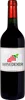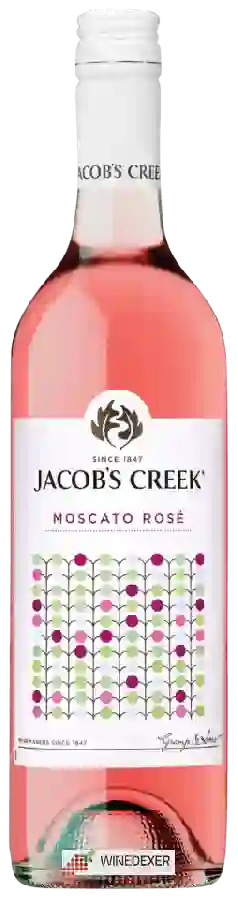
Winery Jacob's CreekMoscato Rosé
 Pink wine


This wine generally goes well with sweet desserts
Wine flavors and olphactive analysis






On the nose the Moscato Rosé of Winery Jacob's Creek in the region of Australie du Sud-Est often reveals types of flavors of grapefruit, citrus or peach and sometimes also flavors of strawberries, vanilla or raspberry.
Food and wine pairings with Moscato Rosé
Pairings that work perfectly with Moscato Rosé

Original food and wine pairings with Moscato Rosé
The Moscato Rosé of Winery Jacob's Creek matches generally quite well with dishes of sweet desserts such as recipes of tiramisu (original recipe).
Details and technical informations about Winery Jacob's Creek's Moscato Rosé.
Discover the grape variety: Marquette
Direct producer hybrid, interspecific cross between MN 1094 and Ravat noir obtained in 1989 by Peter Hemstad and James Luby at the University of Minnesota Research Center (United States). Note that it is the cousin of the black frontenac and the grandson of the pinot noir. It can be found in North America, Canada, ... in France it is almost unknown.
Last vintages of this wine

The best vintages of Moscato Rosé from Winery Jacob's Creek are 2017, 2016, 2015, 2014 and 2019.
Informations about the Winery Jacob's Creek
The Winery Jacob's Creek is one of of the world's greatest estates. It offers 251 wines for sale in the of Australie du Sud-Est to come and discover on site or to buy online.

The wine region of Australie du Sud-Est
South East Australia is a geographical indication (GI) covering the entire south-eastern third of Australia. The western boundary of this area extends 2,000 kilometres (1,250 miles) across the Australian continent from the Pacific coast of Queensland to the Southern Ocean coast of South Australia. This vast wine 'super zone' effectively encompasses all the major Australian wine regions outside Western Australia. Rainforest, mountain ranges, scrubland, desert and Dry riverbeds occupy the majority of the land in the South East Australian area.
The word of the wine: Consistency
In tasting, it is the equivalent of chewing (the chewiness of a tannic red wine is also mentioned). We then speak of firmness, fluidity, softness, hardness, and why not the crunchiness of an early wine by reference to the grape.