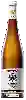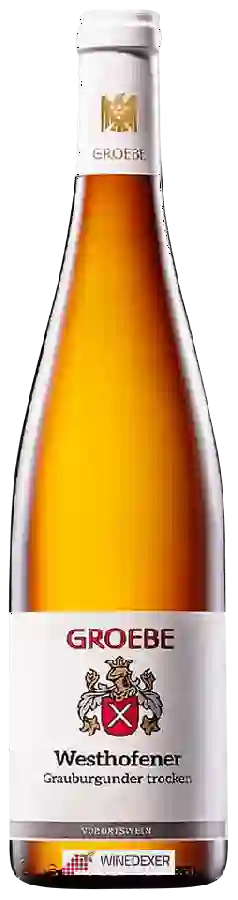
Winery GroebeWesthofener Grauburgunder Trocken
 White wine
In the mouth this white wine is a .
This wine generally goes well with pork, cured meat or mushrooms.
Taste structure of the Westhofener Grauburgunder Trocken from the Winery Groebe
Light | Bold | |
Dry | Sweet | |
Soft | Acidic |
In the mouth the Westhofener Grauburgunder Trocken of Winery Groebe in the region of Rheinhessen is a .
Food and wine pairings with Westhofener Grauburgunder Trocken
Pairings that work perfectly with Westhofener Grauburgunder Trocken


Original food and wine pairings with Westhofener Grauburgunder Trocken

The Westhofener Grauburgunder Trocken of Winery Groebe matches generally quite well with dishes of pork, spicy food or mushrooms such as recipes of jambalaya (louisiana), curried veal roulades or risotto with porcini mushrooms.
Details and technical informations about Winery Groebe's Westhofener Grauburgunder Trocken.
Discover the grape variety: Cornalin d'Aoste
It is a variety of Valle d'Aosta origin and, like Arvine, it is also found in Italy. In the past, it was cultivated in Savoy and registered in the official catalogue of wine grape varieties, list B, under the name of red humagne, but it is not related to white humagne. According to recent genetic analyses, the Swiss variety Cornalin du Valais is its father and Rèze its grandmother. It is also the grandson of the petit rouge d' Aoste.
Informations about the Winery Groebe
The Winery Groebe is one of of the world's great estates. It offers 33 wines for sale in the of Rheinhessen to come and discover on site or to buy online.

The wine region of Rheinhessen
Rheinhessen is Germany's largest region for producing the quality wines of the Qualitätswein bestimmter Anbaugebiete (QbA) and Prädikatswein designations, with roughly 26,500 hectares (65,000 acres) of Vineyard">Vineyards as of 2014. Many of its most significant viticultural areas are favorably influenced by the Rhine river, which runs aLong its North and eastern borders. The Rhine, along with the Nahe river to the west and the Haardt mountains to its South, form a natural border. Rheinhessen covers an area south of Rheingau, north of Pfalz and east of Nahe, and is located within the Rhineland-Palatinate federal state.
The word of the wine: Aging
Period during which a wine is kept in a cellar where it goes through different phases of evolution of its aromatic range and a maturation of its constituents (evolution of the colour, refining of the tannins, harmonization of the different flavours, etc.). The wine evolves better and less quickly in large containers, whereas it deteriorates prematurely in half-bottles.