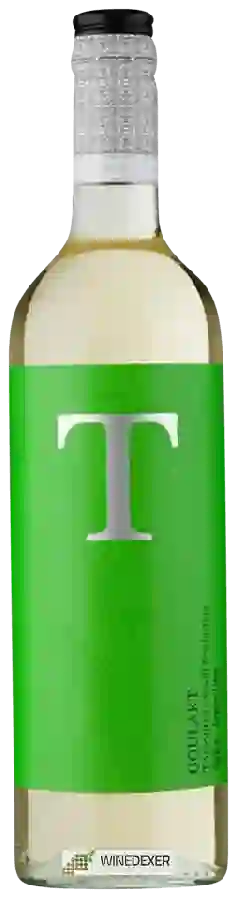
Winery GoulartT Torrontés
 White wine


In the mouth this white wine is a powerful with a nice freshness.
This wine generally goes well with vegetarian, spicy food or aperitif.
Taste structure of the T Torrontés from the Winery Goulart
Light | Bold | |
Dry | Sweet | |
Soft | Acidic |
In the mouth the T Torrontés of Winery Goulart in the region of Salta is a powerful with a nice freshness.
Wine flavors and olphactive analysis

On the nose the T Torrontés of Winery Goulart in the region of Salta often reveals types of flavors of tree fruit, citrus fruit.
Food and wine pairings with T Torrontés
Pairings that work perfectly with T Torrontés



Original food and wine pairings with T Torrontés
The T Torrontés of Winery Goulart matches generally quite well with dishes of spicy food, vegetarian or aperitif such as recipes of monkfish armorican style, magic cake cheese quiche or rice and cheese ball.
Details and technical informations about Winery Goulart's T Torrontés.
Discover the grape variety: Prima
Cross between lival and cardinal obtained in 1974. It has been registered in the official catalogue of table grape varieties, list A1, since 1996.
Last vintages of this wine

The best vintages of T Torrontés from Winery Goulart are 2018, 2019, 2014, 2015 and 2013.
Informations about the Winery Goulart
The Winery Goulart is one of of the world's great estates. It offers 55 wines for sale in the of Salta to come and discover on site or to buy online.

The wine region of Salta
Salta, in the far North of Argentina, is home to some of the world's most extreme Vineyard sites. As is the case in Catamarca to the South and Jujuy to the northwest, Salta's vineyards are often located amid mountainous terrain with some reaching altitudes of just over 3,000 meters (9840ft) above sea level. The viticultural area is mainly concentrated to Cafayate of the Calchaqui Valley. Argentina's signature Grape varieties of Torrontes and Malbec are Salta's top performers, producing Bright, intensely flavored wines.
The word of the wine: Shipping (liquor)
In champagne and wines made according to the traditional method, wine is added before corking to fill the void in the bottle created by disgorging. This added wine is often sweetened by sugar incorporated in variable proportions according to the style of wine sought (see dosage). Syn.: liqueur de dosage.