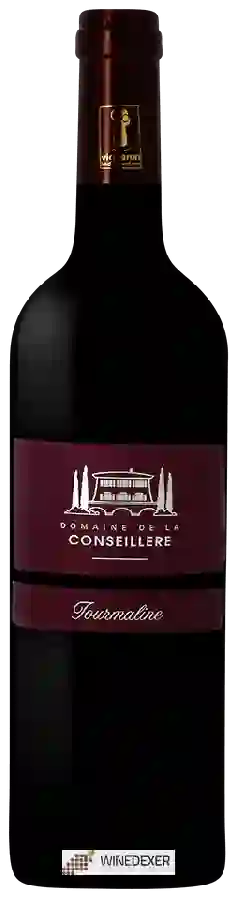
Domaine de la ConseillèreTourmaline
 Red wine



This wine is a blend of 2 varietals which are the Cabernet-Sauvignon and the Merlot.
In the mouth this red wine is a with a nice freshness.
This wine generally goes well with poultry, beef or veal.

Taste structure of the Tourmaline from the Domaine de la Conseillère
Light | Bold | |
Smooth | Tannic | |
Dry | Sweet | |
Soft | Acidic |
In the mouth the Tourmaline of Domaine de la Conseillère in the region of Burgundy is a with a nice freshness.
Food and wine pairings with Tourmaline
Pairings that work perfectly with Tourmaline



Original food and wine pairings with Tourmaline

The Tourmaline of Domaine de la Conseillère matches generally quite well with dishes of beef, veal or game (deer, venison) such as recipes of beef bourguignon with tomato, paupiettes in a casserole with cream or rabbit with cider and mushrooms.
Details and technical informations about Domaine de la Conseillère's Tourmaline.
Discover the grape variety: Cabernet-Sauvignon
Structured, tannic reds, deeply coloured, with aromas of blackcurrant, blackberry, cedar, tobacco and graphite, underpinned by firm acidity and fine ageing potential. Cornerstone of the great Médoc estates (Pauillac, Saint-Estèphe, Saint-Julien) and signature of Napa Valley, Coonawarra and Maipo. The world's most planted red variety, a natural cross of Cabernet Franc x Sauvignon Blanc born in Bordeaux.
Last vintages of this wine
The best vintages of Tourmaline from Domaine de la Conseillère are 2014, 2013, 0
Informations about the Domaine de la Conseillère
The Domaine de la Conseillère is one of of the world's greatest estates. It offers 14 wines for sale in the of Burgundy to come and discover on site or to buy online.

The wine region of Burgundy
Absolute reference for great terroir wines: opulent, mineral Chardonnay in whites (chiselled Chablis, buttery Meursault, majestic Montrachet), fine and silky Pinot Noir in reds (full-bodied Gevrey, structured Pommard, delicate Volnay). Exceptional age-worthy wines with complex notes - red fruits, undergrowth, butter, hazelnut. Some lively Aligoté and light Gamay (Mâconnais). 29,500 ha, 84 tiered AOCs (Régionale, Village, 1er Cru, Grand Cru), 1,247 UNESCO Climats.
The word of the wine: Aging
Period during which a wine is kept in a cellar where it goes through different phases of evolution of its aromatic range and a maturation of its constituents (evolution of the colour, refining of the tannins, harmonization of the different flavours, etc.). The wine evolves better and less quickly in large containers, whereas it deteriorates prematurely in half-bottles.


