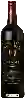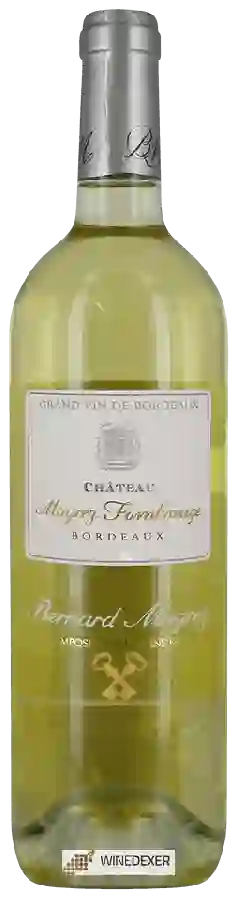
Château FombraugeChateau Magrez Fombrauge Bordeaux Blanc
 White wine


In the mouth this white wine is a powerful.
This wine generally goes well with pork, vegetarian or poultry.
Taste structure of the Chateau Magrez Fombrauge Bordeaux Blanc from the Château Fombrauge
Light | Bold | |
Dry | Sweet | |
Soft | Acidic |
In the mouth the Chateau Magrez Fombrauge Bordeaux Blanc of Château Fombrauge in the region of Bordeaux is a powerful.
Wine flavors and olphactive analysis





On the nose the Chateau Magrez Fombrauge Bordeaux Blanc of Château Fombrauge in the region of Bordeaux often reveals types of flavors of pineapple, oaky or citrus and sometimes also flavors of apples, butter or lime.
Food and wine pairings with Chateau Magrez Fombrauge Bordeaux Blanc
Pairings that work perfectly with Chateau Magrez Fombrauge Bordeaux Blanc



Original food and wine pairings with Chateau Magrez Fombrauge Bordeaux Blanc


The Chateau Magrez Fombrauge Bordeaux Blanc of Château Fombrauge matches generally quite well with dishes of pork, vegetarian or poultry such as recipes of chicken bonne femme, nanie's diced ham quiche or yakitori chicken (japanese).
Details and technical informations about Château Fombrauge's Chateau Magrez Fombrauge Bordeaux Blanc.
Discover the grape variety: Muscat reine des vignes
Obtained in Hungary in 1916 by Jean (Janos) Mathiasz by crossing the Beirut date tree with the Csaba pearl. This variety is nowadays very little multiplied, but it is registered in the Official Catalogue of table grape varieties list A1.
Last vintages of this wine

The best vintages of Chateau Magrez Fombrauge Bordeaux Blanc from Château Fombrauge are 2011, 2010, 2014, 2013 and 2012.
Informations about the Château Fombrauge
The Château Fombrauge is one of of the world's greatest estates. It offers 20 wines for sale in the of Bordeaux to come and discover on site or to buy online.

The wine region of Bordeaux
Bordeaux, in southwestern France, is one of the most famous, prestigious and prolific wine regions in the world. The majority of Bordeaux wines (nearly 90% of the production Volume) are the Dry, medium and Full-bodied red Bordeaux blends for which it is famous. The finest (and most expensive) are the wines of the great châteaux of Haut-Médoc and the right bank appellations of Saint-Émilion and Pomerol. The former focuses (at the highest level) on Cabernet Sauvignon, the latter on Merlot.
The word of the wine: Oxidation
Alteration of the wine caused by prolonged contact with oxygen and resulting in a coppery colour with brown reflections and the appearance of typical aromas reminiscent of rancid nuts.