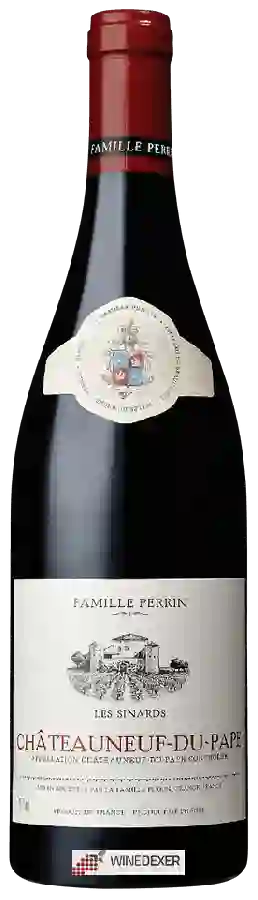
Winery Famille PerrinChâteauneuf-du-Pape Les Sinards Rouge
 Red wine


This wine is a blend of 6 varietals which are the Cabernet franc, the Cabernet-Sauvignon, the Mourvèdre, the Syrah, the Merlot and the Grenache noir.
In the mouth this red wine is a powerful with a nice freshness.
This wine generally goes well with pork, poultry or lamb.

Taste structure of the Châteauneuf-du-Pape Les Sinards Rouge from the Winery Famille Perrin
Light | Bold | |
Smooth | Tannic | |
Dry | Sweet | |
Soft | Acidic |
In the mouth the Châteauneuf-du-Pape Les Sinards Rouge of Winery Famille Perrin in the region of Rhone Valley is a powerful with a nice freshness.
Wine flavors and olphactive analysis






On the nose the Châteauneuf-du-Pape Les Sinards Rouge of Winery Famille Perrin in the region of Rhone Valley often reveals types of flavors of iron, cream or cherry and sometimes also flavors of oaky, citrus or smoke.
Food and wine pairings with Châteauneuf-du-Pape Les Sinards Rouge
Pairings that work perfectly with Châteauneuf-du-Pape Les Sinards Rouge



Original food and wine pairings with Châteauneuf-du-Pape Les Sinards Rouge
The Châteauneuf-du-Pape Les Sinards Rouge of Winery Famille Perrin matches generally quite well with dishes of lamb, pork or poultry such as recipes of braised lamb with peppers, cannelloni of meat or chicken fajitas.
Details and technical informations about Winery Famille Perrin's Châteauneuf-du-Pape Les Sinards Rouge.
Discover the grape variety: Cabernet franc
Supple, fragrant reds with fine tannins and vibrant freshness, showing raspberry, violet, green pepper, pencil lead and gentle spice aromas. Star of the Loire as a single variety (Chinon, Bourgueil, Saumur-Champigny) and of the right bank of Bordeaux in blends (Cheval Blanc at 60%). Also in semi-dry Anjou rosés. A historic Bordeaux variety, parent of Cabernet-Sauvignon, Merlot and Carmenère.
Last vintages of this wine
The best vintages of Châteauneuf-du-Pape Les Sinards Rouge from Winery Famille Perrin are 2020, 2019, 2018, 2017 and 2016.
Informations about the Winery Famille Perrin
The Winery Famille Perrin is one of of the world's greatest estates. It offers 101 wines for sale in the of Châteauneuf-du-Pape to come and discover on site or to buy online.

The wine region of Châteauneuf-du-Pape
Pinnacle of great southern Rhône reds, up to 13 blended grapes: signature Grenache as king — powerful and structured with notes of black cherry, kirsch, garrigue, leather, tar and sweet spices, firm tannins when young and gamey complexity with ageing. Deep Syrah, dense Mourvèdre and supple Cinsault complete it. Rare full whites (Grenache Blanc, Clairette, Roussanne) with almond, anise, honeysuckle notes. Legendary AOC (1936), rolled pebbles, mistral and sun.
The wine region of Rhone Valley
France's 2nd-largest AOC vineyard, two complementary worlds. Northern: pure Syrah in signature reds (Côte-Rôtie, Hermitage, Cornas), deep and peppery with blackberry, violet, black olive and smoked bacon notes, exceptional ageing. Opulent Viognier whites (Condrieu, apricot, flowers) and ample Marsanne-Roussanne. Southern: sun-soaked Grenache blends at Châteauneuf, Gigondas, Vacqueyras (candied fruit, garrigue).
The word of the wine: Tired
Wine that is too old, faded or has suffered from handling such as racking or bottling. In the first case it is too late, in the second case the wine must be put to rest for a few weeks in the cellar.