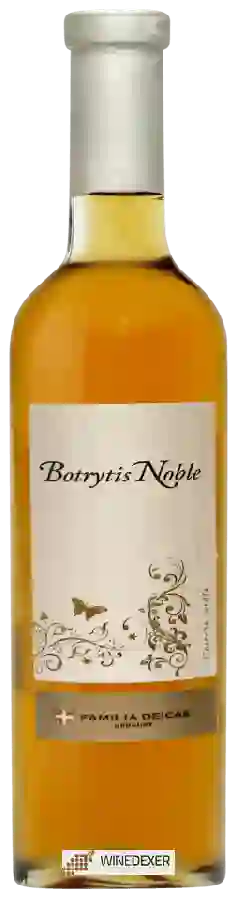
Winery Familia DeicasBotrytis Noble Cosecha Tardia
 Sweet wine


This wine is a blend of 4 varietals which are the Gewurztraminer, the Gros Manseng, the Tannat and the Merlot.
This wine generally goes well with vegetarian, poultry or beef.
The Botrytis Noble Cosecha Tardia of the Winery Familia Deicas is in the top 10 of wines of Juanico.

Wine flavors and olphactive analysis




On the nose the Botrytis Noble Cosecha Tardia of Winery Familia Deicas in the region of Canelones often reveals types of flavors of peach, apricot or honey and sometimes also flavors of earth, tree fruit or citrus fruit.
Food and wine pairings with Botrytis Noble Cosecha Tardia
Pairings that work perfectly with Botrytis Noble Cosecha Tardia



Original food and wine pairings with Botrytis Noble Cosecha Tardia



The Botrytis Noble Cosecha Tardia of Winery Familia Deicas matches generally quite well with dishes of beef, game (deer, venison) or rich fish (salmon, tuna etc) such as recipes of baked lasagna, roast pheasant or cream and tuna quiche.
Details and technical informations about Winery Familia Deicas's Botrytis Noble Cosecha Tardia.
Discover the grape variety: Gewurztraminer
Full-bodied, exotic whites, rich and heady, with moderate acidity, showing opulent aromas of lychee, rose, mango, ginger, pink grapefruit and gentle spice. Made as aromatic dry, moelleux late-harvest and liquorous sélection de grains nobles. Star of Alsace AOC (one of the four noble varieties) and signature of Alto Adige (Tramin), Palatinate and Germany. A pink mutation of Traminer.
Last vintages of this wine

The best vintages of Botrytis Noble Cosecha Tardia from Winery Familia Deicas are 2015, 2017, 2009, 2013 and 2010.
Informations about the Winery Familia Deicas
The Winery Familia Deicas is one of of the world's great estates. It offers 86 wines for sale in the of Juanico to come and discover on site or to buy online.

The wine region of Juanico
Canelones department northeast of Montevideo (Uruguay), ~60% of national production, clay-limestone soils, temperate oceanic climate. Signature Tannat as red king (national variety, exceeds French output): deep and fleshy with black mulberry, candied cherry, plum, cocoa, leather, tobacco and spices, firm tannins and structured palate — South American version of Madiran. Firm Cabernet, supple Merlot. Fresh Chardonnay-Pinot sparkling wines.
The wine region of Canelones
Uruguay's main region north of Montevideo (~90% of national output). National star Tannat: powerful, structured reds with signature notes of blackberry, black plum, violet, leather, tobacco and spice, firm tannins and notable ageing potential — more Tannat planted here than in Madiran, its birthplace. Also round Merlot, peppery Cabernet Franc, spicy Syrah. Fresh saline Albarino whites.
The word of the wine: Tiled
Said of the colour of an evolved wine that has taken on brick and orange hues.