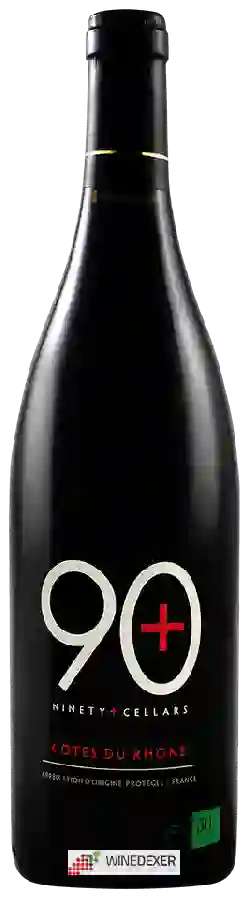
Winery 90+ CellarsLot 30 Côtes du Rhône
 Red wine


In the mouth this red wine is a powerful with a nice balance between acidity and tannins.
This wine generally goes well with beef, game (deer, venison) or lamb.
The Lot 30 Côtes du Rhône of the Winery 90+ Cellars is in the top 30 of wines of Côtes-du-Rhône.
Taste structure of the Lot 30 Côtes du Rhône from the Winery 90+ Cellars
Light | Bold | |
Smooth | Tannic | |
Dry | Sweet | |
Soft | Acidic |
In the mouth the Lot 30 Côtes du Rhône of Winery 90+ Cellars in the region of Rhone Valley is a powerful with a nice balance between acidity and tannins.
Wine flavors and olphactive analysis



On the nose the Lot 30 Côtes du Rhône of Winery 90+ Cellars in the region of Rhone Valley often reveals types of flavors of cherry, earthy or plum and sometimes also flavors of raspberry, earth or oak.
Food and wine pairings with Lot 30 Côtes du Rhône
Pairings that work perfectly with Lot 30 Côtes du Rhône



Original food and wine pairings with Lot 30 Côtes du Rhône
The Lot 30 Côtes du Rhône of Winery 90+ Cellars matches generally quite well with dishes of beef, lamb or game (deer, venison) such as recipes of korean bibimbap, lamb meatballs with mint or duck breast with spices, roasted figs with honey and port.
Details and technical informations about Winery 90+ Cellars's Lot 30 Côtes du Rhône.
Discover the grape variety: Mouyssaguès
Mouyssaguès is a grape variety that originated in the southwest of France. Today it occupies just under a hectare, whereas in the past it filled the entire Lot valley. Its adult leaves have between 7 and 9 lobes. These turn completely red in the autumn. Its blue-black berries are elliptical and short. As for its truncated cone-shaped bunches, they are of medium size. They are also compact and winged. Mouyssaguès has only one approved clone, 1.150. A dozen others have been planted in Aveyron. Mouyssaguès can bud in the middle or late, 8 to 10 days after Chasselas. It ripens early for the second time. Vigorous, it is not very sensitive to the various diseases common to these grape varieties. Although productive, it is preferable to prune it long. The mouyssaguès makes a very astringent and coloured wine. This variety can also be called negret, faroneux, rouge menu or peyregord. Because of its high yield, it is often called the poor man's vine.
Last vintages of this wine

The best vintages of Lot 30 Côtes du Rhône from Winery 90+ Cellars are 2017, 2012, 2014, 2011 and 2016.
Informations about the Winery 90+ Cellars
The Winery 90+ Cellars is one of of the world's great estates. It offers 193 wines for sale in the of Côtes-du-Rhône to come and discover on site or to buy online.

The wine region of Côtes-du-Rhône
The wine region of Côtes-du-Rhône is located in the region of Rhône méridional of Rhone Valley of France. Wineries and vineyards like the Château de Beaucastel or the Chateau de Fonsalette produce mainly wines red, white and pink. The most planted grape varieties in the region of Côtes-du-Rhône are Mourvèdre, Viognier and Marsanne, they are then used in wines in blends or as a single variety. On the nose of Côtes-du-Rhône often reveals types of flavors of pineapple, red plum or sour cherry and sometimes also flavors of truffle, juniper or clove.
The wine region of Rhone Valley
The Rhone Valley is a key wine-producing region in Southeastern France. It follows the North-south course of the Rhône for nearly 240 km, from Lyon to the Rhône delta (Bouches-du-Rhône), near the Mediterranean coast. The Length of the valley means that Rhône wines are the product of a wide variety of soil types and mesoclimates. The viticultural areas of the region cover such a distance that there is a widely accepted division between its northern and southern parts.
The word of the wine: Malolactic fermentation
Called second fermentation or malo for short. It is the degradation (under the effect of bacteria) of the malic acid naturally present in the wine into milder, less aggressive lactic acid. Some producers or wineries refuse this operation by "blocking the malo" (by cold and adding SO2) to keep a maximum of acidity which carries the aromas and accentuates the sensation of freshness.