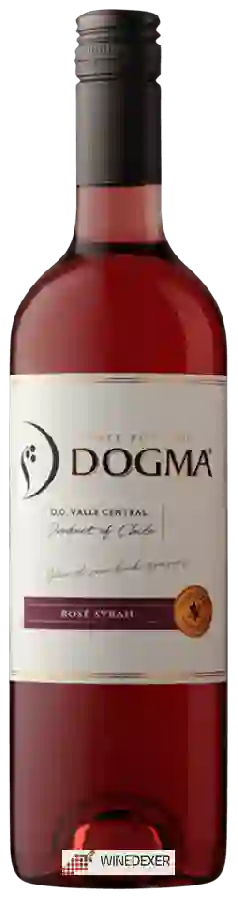
Winery DogmaRosé Syrah
 Pink wine



This wine generally goes well with beef, lamb or mature and hard cheese.
Food and wine pairings with Rosé Syrah
Pairings that work perfectly with Rosé Syrah



Original food and wine pairings with Rosé Syrah

The Rosé Syrah of Winery Dogma matches generally quite well with dishes of beef, lamb or spicy food such as recipes of alsatian bäckeoffe, tunisian haja or chicken with courgettes and curry.
Details and technical informations about Winery Dogma's Rosé Syrah.
Discover the grape variety: Planta nova
A very old indigenous grape variety that has been cultivated for a very long time in Spain, more precisely in the western region of Valencia, where it is practically no longer multiplied today. It is said to be the result of a natural cross between the heftakilo and the rojal tinta, which are both black varieties. Planta nova can still be found in Portugal, Argentina, South Africa, ... almost unknown in France. A long time ago it was also harvested as a table grape, which is no longer the case today.
Last vintages of this wine
The best vintages of Rosé Syrah from Winery Dogma are 0
Informations about the Winery Dogma
The Winery Dogma is one of of the world's great estates. It offers 22 wines for sale in the of Maule Valley to come and discover on site or to buy online.

The wine region of Maule Valley
Maule Valley is the largest wine-producing region in Chile other than the Central Valley, of which it is a Part. It has 75,000 acres (30,000ha) under Vine, and has traditionally been associated with quantity rather than quality. But this is rapidly changing – the bulk-producing Pais vine is gradually being replaced with more international varieties such as Cabernet Sauvignon and Carmenère, and careful winemaking practices are being employed to make some world-class red wines from old-vine Carignan. The Central Valley itself runs between the Andes and the Coastal Mountains from the Chilean capital of Santiago in the North to the up-and-coming region of Bío Bío in the South.
The wine region of Central Valley
The Central Valley (El Valle Central) of Chile is one of the most important wine-producing areas in South America in terms of Volume. It is also one of the largest wine regions, stretching from the Maipo Valley (just south of Santiago) to the southern end of the Maule Valley. This is a distance of almost 250 miles (400km) and covers a number of Climate types. The Central Valley wine region is easily (and often) confused with the geological Central Valley, which runs north–south for more than 620 miles (1000km) between the Pacific Coastal Ranges and the lower Andes.
The word of the wine: Tanin
A natural compound contained in the skin of the grape, the seed or the woody part of the bunch, the stalk. The maceration of red wines allows the extraction of tannins, which give the texture, the solidity and also the mellowness when the tannins are "ripe". The winemaker seeks above all to extract the tannins from the skin, the ripest and most noble. The tannins of the seed or stalk, which are "greener", especially in average years, give the wine hardness and astringency. The wines of Bordeaux (based on Cabernet and Merlot) are full of tannins, those of Burgundy much less so, with Pinot Noir containing little.