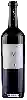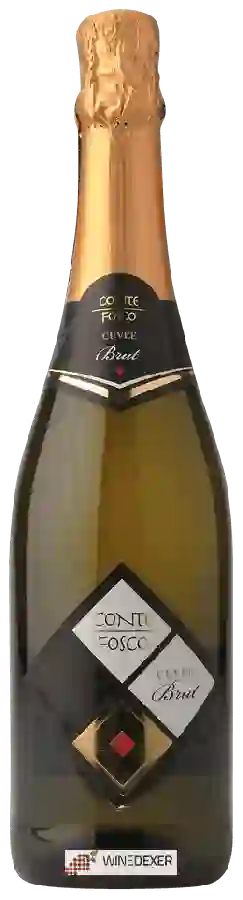
Winery Conte FoscoCuvèe Brut
 Sparkling wine


This wine generally goes well with pork, beef or lamb.
Wine flavors and olphactive analysis


On the nose the Cuvèe Brut of Winery Conte Fosco in the region of Emilia-Romagna often reveals types of flavors of earth, microbio or tree fruit and sometimes also flavors of citrus fruit.
Food and wine pairings with Cuvèe Brut
Pairings that work perfectly with Cuvèe Brut



Original food and wine pairings with Cuvèe Brut

The Cuvèe Brut of Winery Conte Fosco matches generally quite well with dishes of beef, lamb or pork such as recipes of navarin of the sea da gigi, trapper's barbecue or pork chops with mustard.
Details and technical informations about Winery Conte Fosco's Cuvèe Brut.
Discover the grape variety: Putzcheere
It is believed to have originated in Hungary, in the region bordering Romania, from where it spread to Germany, Alsace and the southwest of France, particularly in the Gers and high Pyrenees departments. It is also found in the United States (California). Today, it is almost absent from French vineyards. - Synonyms: putchir, putscher, butschera (for all the synonyms of the grape varieties, click here!)
Last vintages of this wine

The best vintages of Cuvèe Brut from Winery Conte Fosco are 2001, 2014, 0
Informations about the Winery Conte Fosco
The Winery Conte Fosco is one of of the world's greatest estates. It offers 15 wines for sale in the of Emilia-Romagna to come and discover on site or to buy online.

The wine region of Emilia-Romagna
Romagna/emilia">Emilia-Romagna is a Rich and fertile region in Northern Italy, and one of the country's most prolific wine-producing regions, with over 58,000 hectares (143,320 acres) of vines in 2010. It is 240 kilometers (150 miles) wide and stretches across almost the entire northern Italian peninsula, sandwiched between Tuscany to the South, Lombardy and Veneto to the north and the Adriatic Sea to the east. Nine miles of Liguria is all that separates Emilia-Romagna from the Ligurian Sea, and its uniqueness as the only Italian region with both an east and west coast. Emilia-Romagna's wine-growing heritage dates back to the seventh century BC, making it one of the oldest wine-growing regions in Italy.
The word of the wine: Blanc de blancs (champagne)
Champagne made only from the Chardonnay grape. The expression has been somewhat overused by the intensive use made of it by certain large distributors of white table wines (or sparkling wines) who were thus seeking to promote their product.