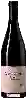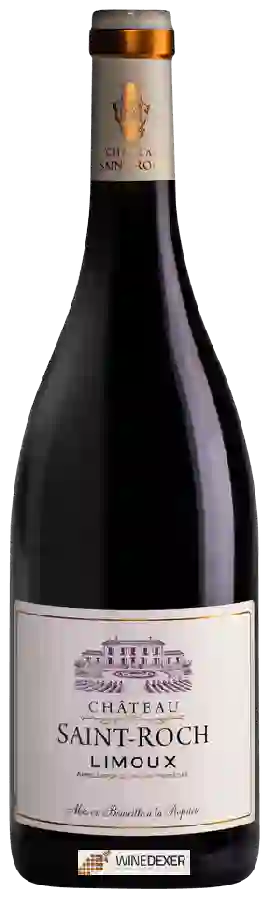
Château Saint-RochLimoux
 Red wine



In the mouth this red wine is a powerful with a nice balance between acidity and tannins.
This wine generally goes well with beef, veal or pasta.
Taste structure of the Limoux from the Château Saint-Roch
Light | Bold | |
Smooth | Tannic | |
Dry | Sweet | |
Soft | Acidic |
In the mouth the Limoux of Château Saint-Roch in the region of Languedoc-Roussillon is a powerful with a nice balance between acidity and tannins.
Wine flavors and olphactive analysis




On the nose the Limoux of Château Saint-Roch in the region of Languedoc-Roussillon often reveals types of flavors of vanilla, non oak or microbio and sometimes also flavors of oak, spices or red fruit.
Food and wine pairings with Limoux
Pairings that work perfectly with Limoux



Original food and wine pairings with Limoux
The Limoux of Château Saint-Roch matches generally quite well with dishes of beef, pasta or veal such as recipes of alsatian bäckeoffe, spaghetti cacio e pepe or veal cutlets with cream sauce.
Details and technical informations about Château Saint-Roch's Limoux.
Discover the grape variety: Irsay Oliver
Obtained in Hungary in 1930 by Pal Kocsis by crossing the pozsonyi fehér (pressburger or white presburg) and the pearl of Csaba. This double-ended variety is found in Hungary, Ukraine, Russia, the Slovak Republic (small Carpathians), the Czech Republic (Moravia), etc. It is virtually unknown in France.
Last vintages of this wine
The best vintages of Limoux from Château Saint-Roch are 2017, 2016, 2015, 2014
Informations about the Château Saint-Roch
The Château Saint-Roch is one of of the world's greatest estates. It offers 13 wines for sale in the of Limoux to come and discover on site or to buy online.

The wine region of Limoux
Limoux is a relatively New appellation (created in 2003) in the eastern Part of the Aude region of Southern France, which applies to both red and white wines. The vineyards extend around the town that gave it its name, in the foothills of the Pyrenees east of the Languedoc-Roussillon/corbieres">Corbières and south of Carcassonne. Historically, this region is best known for its Sparkling wines, which are produced and sold under the appellations of Blanquette de Limoux and Crémant de Limoux. The vineyards here are higher and cooler than those of any other appellation in the Languedoc-Roussillon, and also further away from the moderating temperature influences of the Mediterranean.
The wine region of Languedoc-Roussillon
Languedoc (formerly Coteaux du Languedoc) is a key appellation used in the Languedoc-Roussillon wine region of southern France. It covers Dry table wines of all three colors (red, white and rosé) from the entire region, but leaves Sweet and Sparkling wines to other more specialized appellations. About 75% of all Languedoc wines are red, with the remaining 25% split roughly down the middle between whites and rosés. The appellation covers most of the Languedoc region and almost a third of all the vineyards in France.
The word of the wine: Food and wine pairing
It is the set of techniques that allow for the pleasant combination of food and wine. Food and wine pairing is based on a few basic principles, such as similarity, complementarity or contrast, and involves all the elements that make up the wine and the food (flavours, textures, aromas, etc.).