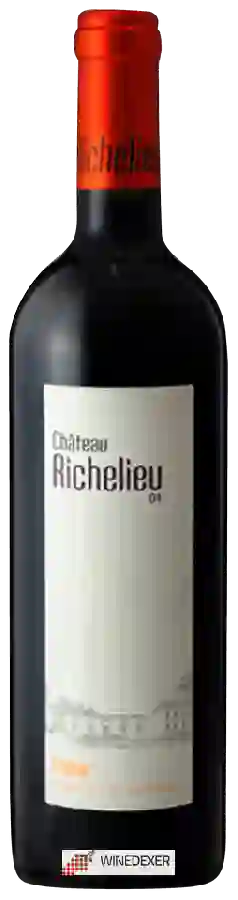
Château RichelieuFronsac
 Red wine


This wine is a blend of 5 varietals which are the Cabernet franc, the Cabernet-Sauvignon, the Malbec, the Petit Verdot and the Merlot.
In the mouth this red wine is a powerful with a nice freshness.
This wine generally goes well with poultry, beef or game (deer, venison).
Taste structure of the Fronsac from the Château Richelieu
Light | Bold | |
Smooth | Tannic | |
Dry | Sweet | |
Soft | Acidic |
In the mouth the Fronsac of Château Richelieu in the region of Bordeaux is a powerful with a nice freshness.
Wine flavors and olphactive analysis



On the nose the Fronsac of Château Richelieu in the region of Bordeaux often reveals types of flavors of non oak, earth or oak and sometimes also flavors of black fruit.
Food and wine pairings with Fronsac
Pairings that work perfectly with Fronsac



Original food and wine pairings with Fronsac

The Fronsac of Château Richelieu matches generally quite well with dishes of beef, lamb or game (deer, venison) such as recipes of polish goulash, marinated leg of lamb with herbs or rabbit with white wine and mushrooms.
Details and technical informations about Château Richelieu's Fronsac.
Discover the grape variety: Cabernet franc
Cabernet Franc is one of the oldest red grape varieties in Bordeaux. The Libourne region is its terroir where it develops best. The terroirs of Saint-Emilion and Fronsac allow it to mature and develop its best range of aromas. It is also the majority in many blends. The very famous Château Cheval Blanc, for example, uses 60% Cabernet Franc. The wines produced with Cabernet Franc are medium in colour with fine tannins and subtle aromas of small red fruits and spices. When blended with Merlot and Cabernet Sauvignon, it brings complexity and a bouquet of aromas to the wine. It produces fruity wines that can be drunk quite quickly, but whose great vintages can be kept for a long time. It is an earlier grape variety than Cabernet Sauvignon, which means that it is planted as far north as the Loire Valley. In Anjou, it is also used to make sweet rosé wines. Cabernet Franc is now used in some twenty countries in Europe and throughout the world.
Last vintages of this wine

The best vintages of Fronsac from Château Richelieu are 2003, 2005, 2006, 2010 and 2004.
Informations about the Château Richelieu
The Château Richelieu is one of of the world's greatest estates. It offers 5 wines for sale in the of Fronsac to come and discover on site or to buy online.

The wine region of Fronsac
The wine region of Fronsac is located in the region of Libournais of Bordeaux of France. Wineries and vineyards like the Château Fontaine-Saint-Cric or the Château Haut-Carles produce mainly wines red, pink and white. The most planted grape varieties in the region of Fronsac are Merlot, Cabernet-Sauvignon and Cabernet franc, they are then used in wines in blends or as a single variety. On the nose of Fronsac often reveals types of flavors of blackberry, dried fruit or black plum and sometimes also flavors of dried herbs, chalk or sweet tobacco.
The wine region of Bordeaux
Bordeaux, in southwestern France, is one of the most famous, prestigious and prolific wine regions in the world. The majority of Bordeaux wines (nearly 90% of the production Volume) are the Dry, medium and Full-bodied red Bordeaux blends for which it is famous. The finest (and most expensive) are the wines of the great châteaux of Haut-Médoc and the right bank appellations of Saint-Émilion and Pomerol. The former focuses (at the highest level) on Cabernet Sauvignon, the latter on Merlot.
The word of the wine: Nose
In tasting, this is the second phase, which consists of identifying the wine's aromas and possibly its defects.