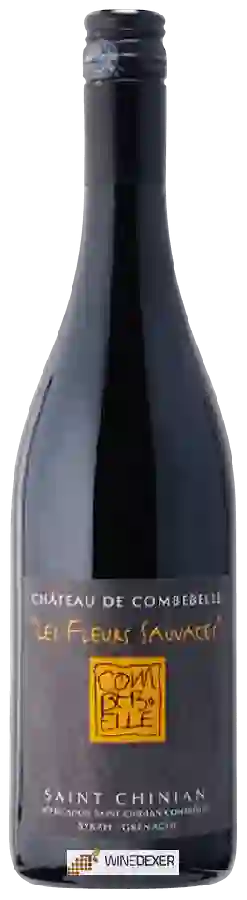
Château de CombebelleLes Fleurs Sauvages Saint-Chinian
 Red wine



In the mouth this red wine is a powerful with a nice balance between acidity and tannins.
This wine generally goes well with beef, veal or pasta.
Taste structure of the Les Fleurs Sauvages Saint-Chinian from the Château de Combebelle
Light | Bold | |
Smooth | Tannic | |
Dry | Sweet | |
Soft | Acidic |
In the mouth the Les Fleurs Sauvages Saint-Chinian of Château de Combebelle in the region of Loire Valley is a powerful with a nice balance between acidity and tannins.
Wine flavors and olphactive analysis

On the nose the Les Fleurs Sauvages Saint-Chinian of Château de Combebelle in the region of Loire Valley often reveals types of flavors of spices.
Food and wine pairings with Les Fleurs Sauvages Saint-Chinian
Pairings that work perfectly with Les Fleurs Sauvages Saint-Chinian



Original food and wine pairings with Les Fleurs Sauvages Saint-Chinian
The Les Fleurs Sauvages Saint-Chinian of Château de Combebelle matches generally quite well with dishes of beef, pasta or veal such as recipes of roast beef with garlic, meat and goat pie or duck breast with orange sauce.
Details and technical informations about Château de Combebelle's Les Fleurs Sauvages Saint-Chinian.
Discover the grape variety: Verdicchio blanc
This grape variety was known for a long time in the central region of Italy and is now cultivated in almost all the wine-producing regions of this country. Under the name of peverella, it can still be found in Brazil, where it has occupied large areas for a long time. In France, it is almost unknown. It would seem that it has many relatives, in particular with varieties of Italian origin, known or little known, without us being able to quote them with certainty because the doubt still remains, to be followed! The pink verdicchio exists but is not related to any of them.
Last vintages of this wine
The best vintages of Les Fleurs Sauvages Saint-Chinian from Château de Combebelle are 2012
Informations about the Château de Combebelle
The Château de Combebelle is one of of the world's greatest estates. It offers 14 wines for sale in the of Chinon to come and discover on site or to buy online.

The wine region of Chinon
The wine region of Chinon is located in the region of Touraine of Loire Valley of France. Wineries and vineyards like the Domaine Marc Brédif or the Château de Saint Louans produce mainly wines red, white and pink. The most planted grape varieties in the region of Chinon are Cabernet franc, Chenin blanc and Cabernet-Sauvignon, they are then used in wines in blends or as a single variety. On the nose of Chinon often reveals types of flavors of cherry, eucalyptus or orange and sometimes also flavors of cola, fig or game.
The wine region of Loire Valley
The Loire Valley is a key wine region in western France. It follows the course of the Loire River on its Long journey through the heart of France, from the inland hills of the Auvergne to the plains of the French Atlantic coast near Nantes (Muscadet country). Important in terms of quantity and quality, the region produces large quantities (about 4 million h/l each year) of everyday wines, as well as some of France's greatest wines. Diversity is another of the region's major assets; the styles of wine produced here range from the light, tangy Muscadet to the Sweet, honeyed Bonnezeaux, the Sparkling whites of Vouvray and the juicy, Tannic reds of Chinon and Saumur.
The word of the wine: Oxidation
Alteration of the wine caused by prolonged contact with oxygen and resulting in a coppery colour with brown reflections and the appearance of typical aromas reminiscent of rancid nuts.