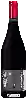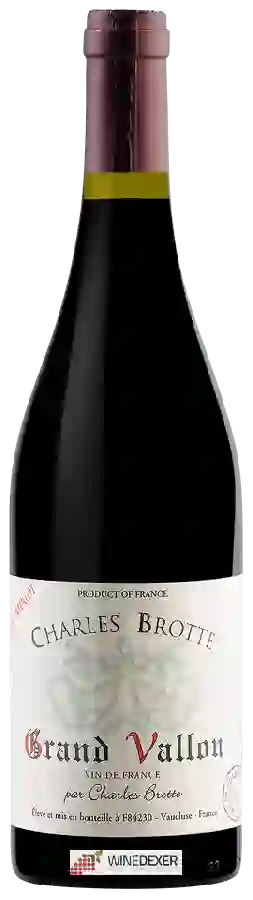
Winery Charles BrotteGrand Vallon
 Red wine



This wine generally goes well with beef, lamb or mature and hard cheese.
Wine flavors and olphactive analysis






On the nose the Grand Vallon of Winery Charles Brotte in the region of Vin de France often reveals types of flavors of cherry, earthy or vanilla and sometimes also flavors of plum, raspberry or pepper.
Food and wine pairings with Grand Vallon
Pairings that work perfectly with Grand Vallon



Original food and wine pairings with Grand Vallon

The Grand Vallon of Winery Charles Brotte matches generally quite well with dishes of beef, lamb or spicy food such as recipes of picadillo, lamb biryani or shrimp marinade.
Details and technical informations about Winery Charles Brotte's Grand Vallon.
Discover the grape variety: Perle de Csaba
It is thought to have originated in Hungary, as Adolf Stark, a winegrower in Bekescsaba (Hungary), created it in 1904. According to genetic analyses, it is the result of a cross between the Madeleine angevine and the Muscat fleur d'oranger. The Csaba pearl has been used to obtain a few crosses (the red Csaba pearl is an example), the aim always being to try to find new varieties with early maturity. Today, it is only found in ornamental gardens, interesting only for its great earliness. Its many defects mean that it is almost on the verge of extinction, although it is included in the official catalogue of vine varieties on the A1 list.
Last vintages of this wine
The best vintages of Grand Vallon from Winery Charles Brotte are 2018, 2000, 2015, 2012 and 2016.
Informations about the Winery Charles Brotte
The Winery Charles Brotte is one of of the world's greatest estates. It offers 13 wines for sale in the of Vin de France to come and discover on site or to buy online.

The wine region of Vin de France
Vin de France is the most basic level of quality for wines from France. These are generally uncomplicated everyday drinks - most often blends, but perhaps also Varietal wines based on a well-known Grape variety such as Cabernet Sauvignon, Merlot, Chardonnay or Sauvignon Blanc. Wines from France are those that do not meet the criteria stipulated by the Protected Designation of Origin (PDO) or Protected Geographical Indication (PGI) laws (see information on French wine labels). This may be because the vineyards are outside the delimited production areas or because the grape varieties or winemaking techniques used do not conform to the rules of the local appellations.
The word of the wine: Extra-dry
Champagne with between 12 and 20 grams of sugar (see dosage liqueur).