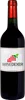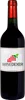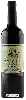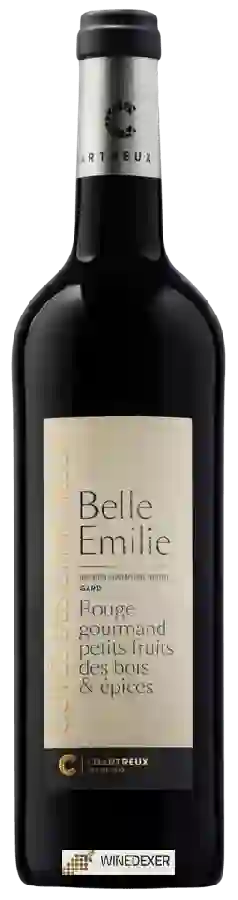
Winery Cellier des ChartreuxCuvée des Chartreux Belle Emilie Rouge
 Red wine


This wine is a blend of 4 varietals which are the Carignan, the Grenache, the Syrah and the Grenache noir.
In the mouth this red wine is a powerful with a nice balance between acidity and tannins.
This wine generally goes well with pork, beef or veal.

Taste structure of the Cuvée des Chartreux Belle Emilie Rouge from the Winery Cellier des Chartreux
Light | Bold | |
Smooth | Tannic | |
Dry | Sweet | |
Soft | Acidic |
In the mouth the Cuvée des Chartreux Belle Emilie Rouge of Winery Cellier des Chartreux in the region of Pays d'Oc is a powerful with a nice balance between acidity and tannins.
Wine flavors and olphactive analysis


On the nose the Cuvée des Chartreux Belle Emilie Rouge of Winery Cellier des Chartreux in the region of Pays d'Oc often reveals types of flavors of oak, tree fruit or red fruit and sometimes also flavors of black fruit.
Food and wine pairings with Cuvée des Chartreux Belle Emilie Rouge
Pairings that work perfectly with Cuvée des Chartreux Belle Emilie Rouge



Original food and wine pairings with Cuvée des Chartreux Belle Emilie Rouge



The Cuvée des Chartreux Belle Emilie Rouge of Winery Cellier des Chartreux matches generally quite well with dishes of beef, veal or pasta such as recipes of wild boar with honey, veal paupiettes with beer or pasta with boursin.
Details and technical informations about Winery Cellier des Chartreux's Cuvée des Chartreux Belle Emilie Rouge.
Discover the grape variety: Carignan
Intensely coloured and powerful reds with a deep colour, firm tannins and high acidity, on aromas of blackberry, blackcurrant, plum, garrigue, pepper, liquorice and balsamic notes. Old vines (>50 years, often centenary) yield exceptional cuvées. A historical pillar of Languedoc-Roussillon blends (Corbières, Minervois, Fitou, Maury) and star of Catalan Priorat under the name Cariñena. Very late-ripening variety from Aragon, also called Mazuelo in Rioja.
Last vintages of this wine

The best vintages of Cuvée des Chartreux Belle Emilie Rouge from Winery Cellier des Chartreux are 2020, 2019, 2023, 2018 and 0.
Informations about the Winery Cellier des Chartreux
The Winery Cellier des Chartreux is one of of the world's great estates. It offers 72 wines for sale in the of Gard to come and discover on site or to buy online.

The wine region of Gard
Vast Languedoc IGP between Costières and Camargue (Gard): signature Grenache, Syrah, Carignan, Mourvèdre and Cinsault as reds and rosés — fruity and sun-drenched with cherry, strawberry, raspberry, garrigue, spice and a peppery touch (Camargue gris rosés emblematic on sand). Floral whites from Grenache Blanc, Marsanne, Viognier and Vermentino. IGP, ~25,000 ha across 24 communes, sunny Mediterranean climate, cleansing mistral.
The wine region of Pays d'Oc
The single-grape IGP par excellence: modern, accessible, frank and fruity wines, the popular signature of the Midi. Spicy Syrah reds (pepper, blackberry), round Merlot, structured Cabernet, generous Grenache, supple Cinsault. Crisp, tangy rosés. Opulent Chardonnay whites, lively Sauvignon, floral, apricoty Viognier.
The word of the wine: Wiring
Action of periodically filling barrels containing wine, in order to offset evaporation and maintain a maximum level. The topping up allows to avoid the phenomenon of oxidation.