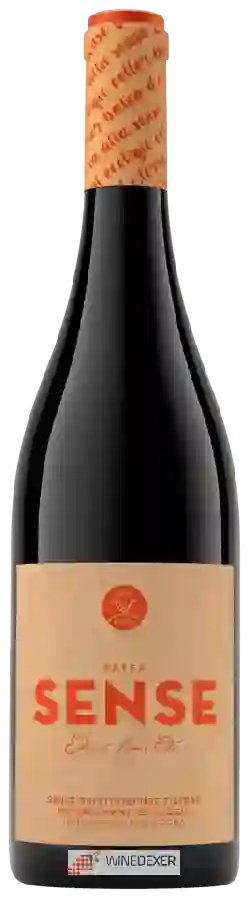
Winery Celler BateaSense Red
 Red wine



In the mouth this red wine is a powerful with a nice freshness.
This wine generally goes well with poultry, beef or game (deer, venison).
Taste structure of the Sense Red from the Winery Celler Batea
Light | Bold | |
Smooth | Tannic | |
Dry | Sweet | |
Soft | Acidic |
In the mouth the Sense Red of Winery Celler Batea in the region of Catalogne is a powerful with a nice freshness.
Food and wine pairings with Sense Red
Pairings that work perfectly with Sense Red



Original food and wine pairings with Sense Red


The Sense Red of Winery Celler Batea matches generally quite well with dishes of beef, pasta or lamb such as recipes of autumn beef bourguignon, maultaschen ( swabian ravioli ) or lamb tagine with honey and dried fruits.
Details and technical informations about Winery Celler Batea's Sense Red.
Discover the grape variety: Suffolk red
Interspecific crossing between the fredonia or early concord and the black monukka - the latter also being called russian seedless or black kischmish - obtained in 1935 by John Einset (1915/1981) at the Agricultural Experimental Station of the State of New-York (United States) ... practically unknown in France except for amateur gardeners, registered however in the Official Catalogue of the varieties of grapevine of table A2 list. Note that it has concord and isabelle as parents.
Last vintages of this wine
The best vintages of Sense Red from Winery Celler Batea are 0, 2018
Informations about the Winery Celler Batea
The Winery Celler Batea is one of of the world's great estates. It offers 32 wines for sale in the of Catalogne to come and discover on site or to buy online.

The wine region of Catalogne
Catalonia (Catalunya in Catalan and Cataluña in Spanish) is an autonomous community in the Northeast of Spain. It extends from the historic county (comarca) of Montsia in the South to the border with France in the north. The Mediterranean Sea forms its eastern border and offers 580 km of coastline. The Catalunya D.
The word of the wine: Flavor
Sensation (sweet, salty, sour or bitter) produced on the tongue by a food.