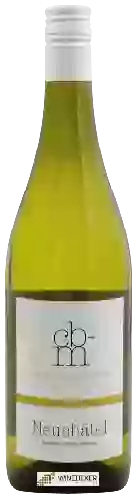
The Cave des Beaux-Monts of Neuchâtel

The Cave des Beaux-Monts is one of the best wineries to follow in Neuchâtel.. It offers 1 wines for sale in of Neuchâtel to come and discover on site or to buy online.
Looking for the best Cave des Beaux-Monts wines in Neuchâtel among all the wines in the region? Check out our tops of the best red, white or effervescent Cave des Beaux-Monts wines. Also find some food and wine pairings that may be suitable with the wines from this area. Learn more about the region and the Cave des Beaux-Monts wines with technical and enological descriptions.
How Cave des Beaux-Monts wines pair with each other generally quite well with dishes such as recipes .
Neuchatel is one of the smaller wine regions of Switzerland, located in the French-speaking western half of the country, North of the much larger Vaud area. Much like its neighbour, Chasselas dominates white plantings here, however Pinot Noir is more significant here, as is the reputation of Neuchatel's rosés.
The region is generally referred to as the 'Three Lakes' as the region - and the four AOCs within it - are found on the relatively low-lying, flatter land, centered around the lakes of Morat, Bienne and Neuchatel.
The region also covers three neighbouring Swiss cantons.
AOPs Cheyres and Vully occupy 105 (260 acres) of the canton of Fribourg (on the shores of Lac de Neuchatel and Morat, respectively), while the Lac de Bienne, or Bielersee (for the generally Swiss-German speaking people of Bern) denomination takes up 222 hectares (550 acres) of the canton of Bern on the lake of Bienne.
The lion's share of the AOP, around 605 hectares (1,500 acres), is in the canton of Neuchatel, mainly on the north shore of the eponymous lake, in the Neuchatel AOP.
Overall, this puts the wine region on what the Swiss refer to as "la plaine" - a relatively flat area of land from Geneva through Bern to ZuRich, sandwiched to the north by the Jura and to the South by the Alps.
The Vineyards here are on relatively low-lying, flatter land, centered around the lakes.
Soils here are light and stony, generally Jurassic and rich in limestone. However, areas with more clay and vigour can also be found.
The Climate is moderated significantly by the presence of the lakes, which prevent summer temperatures from rising dramatically and also dampen the effects of frost and snow in winter. Neuchatel has about-average rainfall of around 1,000mm (39 inches) per year.
Planning a wine route in the of Neuchâtel? Here are the wineries to visit and the winemakers to meet during your trip in search of wines similar to Cave des Beaux-Monts.
Discovered in the 1870s by Mr. Robin, who lived in the Drôme at the time in Lapeyrouse-Mornay, this ancient grape variety is believed to have originated in the north of Isère. It can also be found in Switzerland. According to Thierry Lacombe (I.N.R.A./Montpellier), it is the result of a natural intraspecific crossing between Tressot Noir and Mondeuse Blanche. It should be noted in passing that, on the one hand, it has exactly the same parents as the mondeuse noire, that on the other hand, it is the mother of the diolinoir and, finally, is related to the servanin. Robin noir is not widely propagated today because it is not well known, although it is listed in the Official Catalogue of Wine Grape Varieties, list A1.