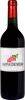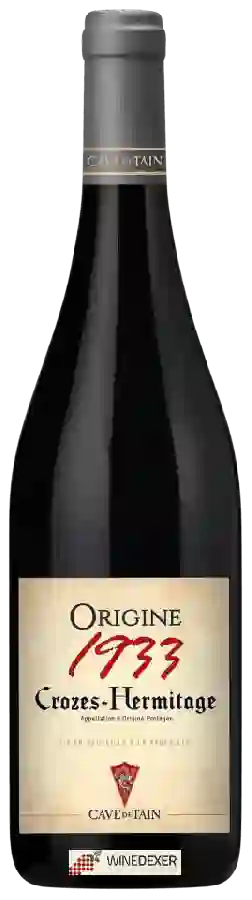
Cave de TainOrigine 1933 Crozes-Hermitage
 Red wine
In the mouth this red wine is a powerful with a nice balance between acidity and tannins.
This wine generally goes well with poultry, beef or game (deer, venison).
Taste structure of the Origine 1933 Crozes-Hermitage from the Cave de Tain
Light | Bold | |
Smooth | Tannic | |
Dry | Sweet | |
Soft | Acidic |
In the mouth the Origine 1933 Crozes-Hermitage of Cave de Tain in the region of Rhone Valley is a powerful with a nice balance between acidity and tannins.
Food and wine pairings with Origine 1933 Crozes-Hermitage
Pairings that work perfectly with Origine 1933 Crozes-Hermitage



Original food and wine pairings with Origine 1933 Crozes-Hermitage

The Origine 1933 Crozes-Hermitage of Cave de Tain matches generally quite well with dishes of beef, lamb or game (deer, venison) such as recipes of burger roll, lamb tagine with onions, purple olives and lemons... or duck breast with goat cheese and local ham.
Details and technical informations about Cave de Tain's Origine 1933 Crozes-Hermitage.
Discover the grape variety: Calabrese
Most certainly of Italian origin, more precisely from Sicily where it is very well known. It should be noted that a certain number of Italian grape varieties bear the synonym or name "calabrese", whether or not followed by an epithet, and care should be taken not to confuse them. Calabrese is also known in the United States, Italy, Bulgaria and Malta. In France, it is virtually absent from the vineyard, although it is listed in the Official Catalogue of Wine Grape Varieties, list A1.
Informations about the Cave de Tain
The Cave de Tain is one of wineries to follow in Crozes-Hermitage.. It offers 219 wines for sale in the of Crozes-Hermitage to come and discover on site or to buy online.

The wine region of Crozes-Hermitage
The wine region of Crozes-Hermitage is located in the region of Rhône septentrional of Rhone Valley of France. Wineries and vineyards like the Domaine Combier or the Domaine M. Chapoutier produce mainly wines red and white. The most planted grape varieties in the region of Crozes-Hermitage are Marsanne, Roussanne and Mourvèdre, they are then used in wines in blends or as a single variety.
The wine region of Rhone Valley
The Rhone Valley is a key wine-producing region in Southeastern France. It follows the North-south course of the Rhône for nearly 240 km, from Lyon to the Rhône delta (Bouches-du-Rhône), near the Mediterranean coast. The Length of the valley means that Rhône wines are the product of a wide variety of soil types and mesoclimates. The viticultural areas of the region cover such a distance that there is a widely accepted division between its northern and southern parts.
The word of the wine: Maturation
Transformation undergone by the grape when it is enriched with sugar and loses some of its acidity to reach maturity.