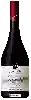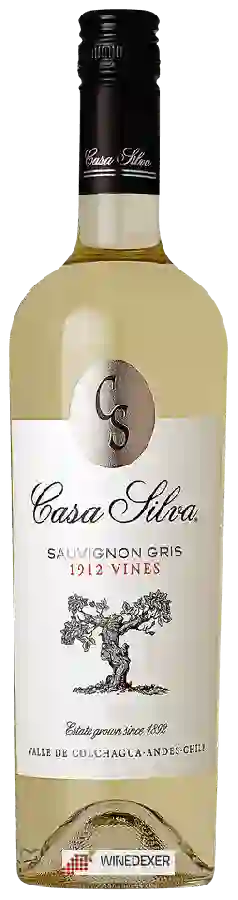
Winery Casa SilvaSauvignon Gris
 White wine



This wine generally goes well with
Wine flavors and olphactive analysis






On the nose the Sauvignon Gris of Winery Casa Silva in the region of Central Valley often reveals types of flavors of non oak, earth or microbio and sometimes also flavors of vegetal, oak or tree fruit.
Details and technical informations about Winery Casa Silva's Sauvignon Gris.
Discover the grape variety: Rousse
It is said to have originated in the Vallée du Gier, south-west of Lyon, and is found only in this region, like the Mornen, with which it has long been associated. It disappeared from the vineyard a long time ago, but is currently being recognized thanks to the association for the restoration and development of the Coteaux du Gier vineyard (A.R.D.V.C.G). A few vines still remain in a mixture in very old plots.
Last vintages of this wine
The best vintages of Sauvignon Gris from Winery Casa Silva are 2009, 2012, 2019, 2018 and 2017.
Informations about the Winery Casa Silva
The Winery Casa Silva is one of of the world's great estates. It offers 93 wines for sale in the of Colchagua Valley to come and discover on site or to buy online.

The wine region of Colchagua Valley
The wine region of Colchagua Valley is located in the region of Rapel Valley of Central Valley of Chile. We currently count 487 estates and châteaux in the of Colchagua Valley, producing 2420 different wines in conventional, organic and biodynamic agriculture. The wines of Colchagua Valley go well with generally quite well with dishes .
The wine region of Central Valley
The Central Valley (El Valle Central) of Chile is one of the most important wine-producing areas in South America in terms of Volume. It is also one of the largest wine regions, stretching from the Maipo Valley (just south of Santiago) to the southern end of the Maule Valley. This is a distance of almost 250 miles (400km) and covers a number of Climate types. The Central Valley wine region is easily (and often) confused with the geological Central Valley, which runs north–south for more than 620 miles (1000km) between the Pacific Coastal Ranges and the lower Andes.
The word of the wine: Lies
A deposit formed by dead yeast after fermentation. Some white wines are aged on their lees, which makes their aromas and structure more complex and richer.