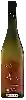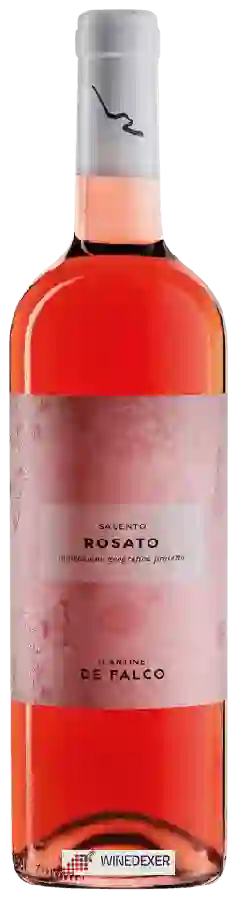
Winery Cantine de FalcoSalento Rosato
 Pink wine



This wine generally goes well with
Details and technical informations about Winery Cantine de Falco's Salento Rosato.
Discover the grape variety: Muscat Ottonel
Muscat Ottonel has the character of a grape variety with a distant lineage. It was first obtained in 1839 and continues to be planted in nearly 2,000 hectares of vineyards around the world. It shows good vigour and promises satisfactory production, of the order of 6 kilos per vine. The bunches, which are rather loose, are quite large, bearing berries with a strong character. A pleasantly musky flavour and a lot of juice characterize the pulp, protected by a medium skin. The bluish-black skin contributes to the exceptional beauty of the vineyards at harvest time. The size of the ellipsoidal berries is another argument in favor of Muscat Ottonel, which is also known as Muscat Ottone or Muscadet Ottonel. Resin, toast, honey and wild flowers are all present in the wines made from this variety. If the foliage, which turns yellow in autumn, is one of its charms, remember to protect the fruit from grey rot and coulure.
Last vintages of this wine
The best vintages of Salento Rosato from Winery Cantine de Falco are 2017, 2018, 0
Informations about the Winery Cantine de Falco
The Winery Cantine de Falco is one of of the world's great estates. It offers 38 wines for sale in the of Salento to come and discover on site or to buy online.

The wine region of Salento
The wine region of Salento is located in the region of Pouilles of Italy. We currently count 851 estates and châteaux in the of Salento, producing 2704 different wines in conventional, organic and biodynamic agriculture. The wines of Salento go well with generally quite well with dishes .
The wine region of Puglia
Puglia (Apulia to many English speakers) is a Long, slender wine region in the extreme Southeast corner of Italy's "boot". To use the shoe analogy often used to illustrate the shape of Italy, Apulia extends from the tip of the heel to the mid-calf, where the spur of the Gargano Peninsula juts out into the Adriatic Sea. The heel (the Salento peninsula) occupies the southern half of the region and is of great importance for the identity of Puglia. Not only are there cultural and geographical differences from Northern Puglia, but the wines are also different.
The word of the wine: Erinosis
Generally benign condition caused by a very small mite. The infested leaves show blisters on the upper surface, sometimes reddish, sometimes green, to which corresponds on the lower surface a dense felting, first pinkish white, then brownish or reddish.