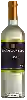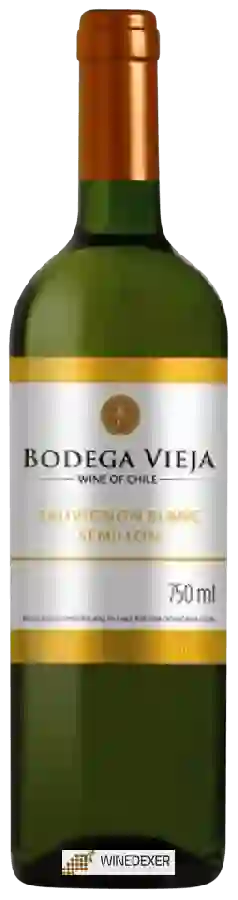
Bodega ViejaSauvignon Blanc - Sémillon
 White wine


This wine generally goes well with vegetarian, poultry or rich fish (salmon, tuna etc).
Food and wine pairings with Sauvignon Blanc - Sémillon
Pairings that work perfectly with Sauvignon Blanc - Sémillon



Original food and wine pairings with Sauvignon Blanc - Sémillon


The Sauvignon Blanc - Sémillon of Bodega Vieja matches generally quite well with dishes of rich fish (salmon, tuna etc), shellfish or sweet desserts such as recipes of pasta with tuna and tomato sauce, scallops with cream or express cherry clafoutis.
Details and technical informations about Bodega Vieja's Sauvignon Blanc - Sémillon.
Discover the grape variety: Italia Rubi
Pink selection made in Brazil, following a natural coloured mutation of the italia, discovered in 1981 by San Giorgio Jonico. Since 24.08.2009, it is registered in the Official Catalogue of table grape varieties, list A1. In Italy, a more colourful mutation of the Rubi was discovered, called benitaka, which is more uniform in berry colour and ripens about a week earlier. The black brasil variety, which can be found in Brazil, is said to be a natural mutation of benitaka. Finally, Rubi should not be confused with ruby seedless, also a pink apyrene grape.
Last vintages of this wine

The best vintages of Sauvignon Blanc - Sémillon from Bodega Vieja are 2014, 2015, 2016, 2010 and 0.
Informations about the Bodega Vieja
The Bodega Vieja is one of of the world's greatest estates. It offers 5 wines for sale in the of Central Valley to come and discover on site or to buy online.

The wine region of Central Valley
The Central Valley (El Valle Central) of Chile is one of the most important wine-producing areas in South America in terms of Volume. It is also one of the largest wine regions, stretching from the Maipo Valley (just south of Santiago) to the southern end of the Maule Valley. This is a distance of almost 250 miles (400km) and covers a number of Climate types. The Central Valley wine region is easily (and often) confused with the geological Central Valley, which runs north–south for more than 620 miles (1000km) between the Pacific Coastal Ranges and the lower Andes.
The word of the wine: Cep
Grapevine.