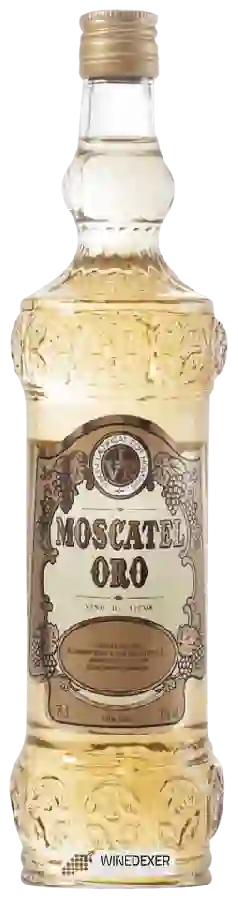
Bodegas ValdepabloMoscatel Oro
 Sweet wine



This wine generally goes well with
Details and technical informations about Bodegas Valdepablo's Moscatel Oro.
Discover the grape variety: Siegerrebe
An intraspecific cross between the Madeleine angevine and the Gewurztraminer obtained in 1929 by Georg Scheu at the Alzey testing station (Germany). Almost unknown in France, it can be found in Germany, Denmark, the Netherlands, Belgium, Sweden, Switzerland, England, the United States, Canada, etc.
Last vintages of this wine
The best vintages of Moscatel Oro from Bodegas Valdepablo are 0
Informations about the Bodegas Valdepablo
The Bodegas Valdepablo is one of of the world's greatest estates. It offers 4 wines for sale in the of Calatayud to come and discover on site or to buy online.

The wine region of Calatayud
The wine region of Calatayud is located in the region of Aragon of Spain. Wineries and vineyards like the Domaine Breca or the Domaine Bodegas Ateca produce mainly wines red, white and pink. The most planted grape varieties in the region of Calatayud are Tempranillo, Cabernet-Sauvignon and Merlot, they are then used in wines in blends or as a single variety. On the nose of Calatayud often reveals types of flavors of red fruit, molasses or salt and sometimes also flavors of nutmeg, dried strawberry or sour cherry.
The wine region of Aragon
Aragon is one of Spain's 17 autonomous communities. Located in the North of the country, it stretches from the imposing Pyrenees mountains in the South to the vast Central Iberian plateau. To the east of Aragon Lies Catalonia, while La Rioja, Castilla y Leon and Navarra are its neighbours to the west. Aragon encompasses the eastward flowing Ebro River and its vast valley, the river being one of the largest and most important in Spain.
The word of the wine: Local wine
Table wine, but with the origin indicated. It corresponds to a particular legislation: the freedom to use grape varieties is greater than for the AOC, but the quality criteria such as the approval tastings can sometimes be more demanding. The legislation is still evolving, but for the moment there are three levels: regional (e.g. Vin de Pays d'Oc), departmental and local (e.g. Côtes de Thongue).