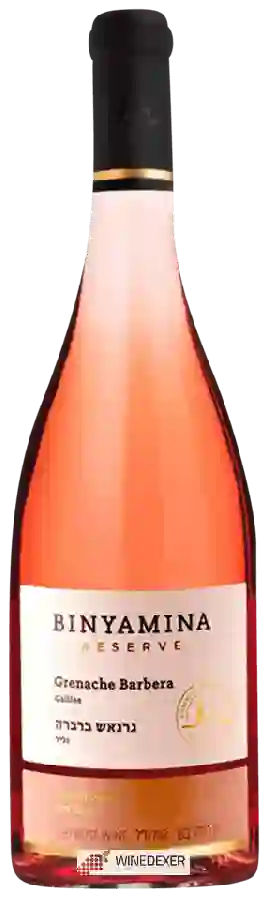
Winery BinyaminaReserve Grenache - Barbera Rosé
 Pink wine


This wine generally goes well with pork, poultry or beef.
Food and wine pairings with Reserve Grenache - Barbera Rosé
Pairings that work perfectly with Reserve Grenache - Barbera Rosé



Original food and wine pairings with Reserve Grenache - Barbera Rosé



The Reserve Grenache - Barbera Rosé of Winery Binyamina matches generally quite well with dishes of beef, pork or spicy food such as recipes of beef with dark beer, stuffed squid in the sétoise sauce or pasta with broccoli.
Details and technical informations about Winery Binyamina's Reserve Grenache - Barbera Rosé.
Discover the grape variety: Riminèse
Riminèse blanc is a grape variety that originated in France (Corsica). It produces a variety of grape specially used for the elaboration of wine. It is rare to find this grape to eat on our tables. The white Riminèse can be found in several vineyards: South-West, Cognac, Bordeaux, Provence & Corsica, Rhone Valley, Loire Valley, Savoie & Bugey, Beaujolais.
Last vintages of this wine

The best vintages of Reserve Grenache - Barbera Rosé from Winery Binyamina are 0, 2017
Informations about the Winery Binyamina
The Winery Binyamina is one of of the world's great estates. It offers 88 wines for sale in the of Galilee to come and discover on site or to buy online.

The wine region of Galilee
Galilee is an administrative and wine region in Northern Israel. Its name is perhaps most widely recognized in the context of Lake Galilee, via its associations with the Bible, but it is now steadily becoming known as a wine region. 'Water into wine' is not a New theme for the Galilee region as the story of the wedding at Cana, in which Jesus turns water into wine, is widely thought to have its origins here. The Galilee (Galil in Hebrew) is located in the northern most reach of the couunty, with Golan Heights to the east and the Coastal Plains to the west.
The word of the wine: Muscat blanc à petits grains
A white grape variety cultivated since antiquity on the shores of the Mediterranean, it is considered the noblest of the muscats. It is mainly used to make sweet wines, often from mutage. In France, it is the sole variety used in many natural sweet wines: muscat-de-frontignan, muscat-de-mireval, muscat-de-lunel, muscat-de-saint-jean-de-minervois, muscat-de-beaumes-de-venise, muscat-du-cap-corse. Combined with Muscat d'Alexandrie, it gives Muscat-de-Rivesaltes. It is also used to make sparkling white wines (clairette-de-die; moscato d'asti and asti spumante in Italy) and dry wines (alsace-muscat). Powerfully aromatic and complex, its wines evoke fresh grapes, roses, exotic fruits, citrus fruits and spices.