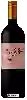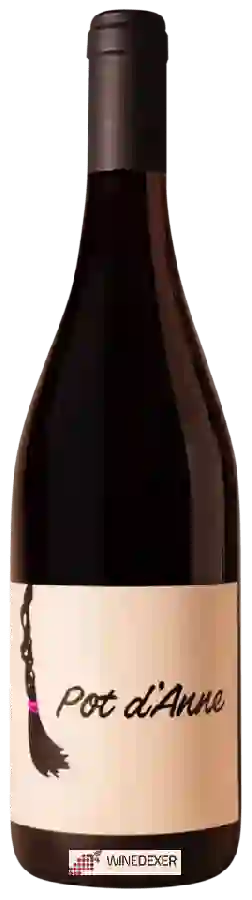
Winery Autour de l'AnnePot d'Anne
 Red wine



In the mouth this red wine is a powerful with a nice balance between acidity and tannins.
This wine generally goes well with beef, veal or pasta.

Taste structure of the Pot d'Anne from the Winery Autour de l'Anne
Light | Bold | |
Smooth | Tannic | |
Dry | Sweet | |
Soft | Acidic |
In the mouth the Pot d'Anne of Winery Autour de l'Anne in the region of Languedoc-Roussillon is a powerful with a nice balance between acidity and tannins.
Wine flavors and olphactive analysis

On the nose the Pot d'Anne of Winery Autour de l'Anne in the region of Languedoc-Roussillon often reveals types of flavors of blueberry, spices or red fruit and sometimes also flavors of black fruit.
Food and wine pairings with Pot d'Anne
Pairings that work perfectly with Pot d'Anne



Original food and wine pairings with Pot d'Anne
The Pot d'Anne of Winery Autour de l'Anne matches generally quite well with dishes of beef, pasta or veal such as recipes of millet with gruyere cheese, flammekueche with munster cheese or veal head with vinaigrette.
Details and technical informations about Winery Autour de l'Anne's Pot d'Anne.
Discover the grape variety: Reichensteiner
Aromatic, lively dry whites with a pale golden hue, supple palate and preserved acidity, with delicate notes of light muscat, white flowers (acacia), citrus, apple and florals. Refreshing, drink young. Early-ripening variety suited to northern climates: grown in Germany (Rheinhessen, Mosel), the UK, New Zealand and Japan. German hybrid created in 1939 at Geisenheim (müller-thurgau × madeleine angevine × calabreser fröhlich).
Last vintages of this wine
The best vintages of Pot d'Anne from Winery Autour de l'Anne are 2013
Informations about the Winery Autour de l'Anne
The Winery Autour de l'Anne is one of of the world's greatest estates. It offers 14 wines for sale in the of Languedoc to come and discover on site or to buy online.

The wine region of Languedoc
Sunny, generous southern reds: spicy, peppery Syrah, round, candied Grenache (ripe fruit, garrigue), deep Mourvèdre, structured Carignan, supple Cinsault. From robust Corbières and Minervois to fresher Terrasses du Larzac, via Faugères on schist or taut Pic Saint-Loup. Lively, iodised Picpoul de Pinet whites (oysters), ample Roussanne and Marsanne. 14 sub-appellations, ~10,000 ha in regional AOC.
The wine region of Languedoc-Roussillon
Largest single French vineyard, dominated by sunny, generous reds. Spicy Syrah, candied Grenache (ripe fruit, garrigue), structured Carignan, deep Mourvèdre, supple Cinsault. Stars: structured Corbières, Minervois, Faugères, Saint-Chinian; round Côtes-du-Roussillon. Legendary vins doux naturels: Banyuls and Maury (fortified Grenache) with notes of cocoa, fig, prune.
The word of the wine: Vatting
After five to eight days of alcoholic fermentation, it is possible to prolong the maceration in order to extract the maximum amount of matter from the marc. The wines obtained in this way are rich and full-bodied, and in principle are intended for laying down.