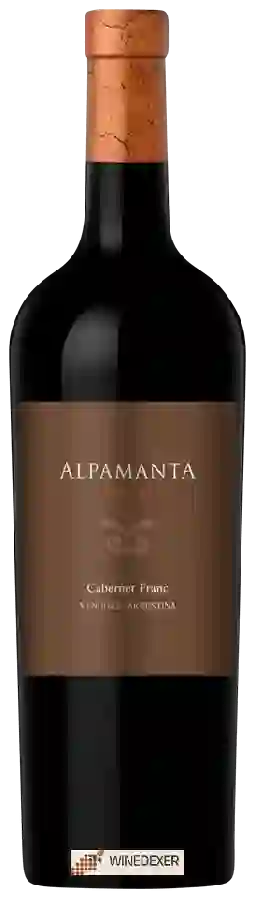
Winery AlpamantaCabernet Franc
 Red wine



This wine is composed of 100% of the grape variety Cabernet Franc.
This wine generally goes well with pork, poultry or beef.

Wine flavors and olphactive analysis

On the nose the Cabernet Franc of Winery Alpamanta in the region of Mendoza often reveals types of flavors of spices.
Food and wine pairings with Cabernet Franc
Pairings that work perfectly with Cabernet Franc



Original food and wine pairings with Cabernet Franc


The Cabernet Franc of Winery Alpamanta matches generally quite well with dishes of beef, pork or game (deer, venison) such as recipes of monkfish with vegetable tagliatelle, turkey roulades, flavoured sauce or baked duck legs with potatoes.
Details and technical informations about Winery Alpamanta's Cabernet Franc.
Discover the grape variety: Cabernet franc
Supple, fragrant reds with fine tannins and vibrant freshness, showing raspberry, violet, green pepper, pencil lead and gentle spice aromas. Star of the Loire as a single variety (Chinon, Bourgueil, Saumur-Champigny) and of the right bank of Bordeaux in blends (Cheval Blanc at 60%). Also in semi-dry Anjou rosés. A historic Bordeaux variety, parent of Cabernet-Sauvignon, Merlot and Carmenère.
Last vintages of this wine
The best vintages of Cabernet Franc from Winery Alpamanta are 2015, 2013, 2011, 0 and 2014.
Informations about the Winery Alpamanta
The Winery Alpamanta is one of of the world's greatest estates. It offers 20 wines for sale in the of Mendoza to come and discover on site or to buy online.

The wine region of Mendoza
World capital of Malbec: powerful, deep reds with blackberry, plum, violet and sweet spice, round tannins and vivid fruit. Also firm Cabernet Sauvignon, supple, juicy Bonarda, aromatic floral white Torrontés. High-altitude vineyards (800-1,700 m) at the foot of the Andes, dry continental climate irrigated by glacial waters. ~80% of Argentine output across 150,000 ha.
The word of the wine: Chaptalization
The addition of sugar at the time of fermentation of the must, an ancient practice, but theorized by Jean-Antoine Chaptal at the dawn of the 19th century. The sugar is transformed into alcohol and allows the natural degree of the wine to be raised in a weak or cold year, or - more questionably - when the winegrower has a harvest that is too large to obtain good maturity.