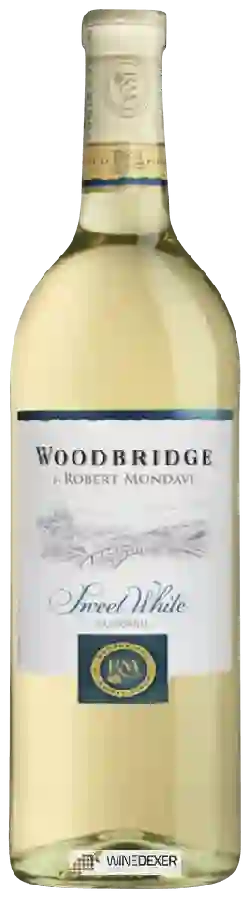
Winery Woodbridge by Robert MondaviSweet White
 White wine



This wine is a blend of 4 varietals which are the Chardonnay, the Gewurztraminer, the Verdelho and the Viognier.
This wine generally goes well with pork, vegetarian or poultry.
Food and wine pairings with Sweet White
Pairings that work perfectly with Sweet White



Original food and wine pairings with Sweet White



The Sweet White of Winery Woodbridge by Robert Mondavi matches generally quite well with dishes of pork, game (deer, venison) or rich fish (salmon, tuna etc) such as recipes of sausages with kale, rabbit legs with mushrooms or english tuna croque-monsieur.
Details and technical informations about Winery Woodbridge by Robert Mondavi's Sweet White.
Discover the grape variety: Chardonnay
The white Chardonnay is a grape variety that originated in France (Burgundy). It produces a variety of grape specially used for wine making. It is rare to find this grape to eat on our tables. This variety of grape is characterized by small bunches, and small grapes. White Chardonnay can be found in many vineyards: South West, Burgundy, Jura, Languedoc & Roussillon, Cognac, Bordeaux, Beaujolais, Savoie & Bugey, Loire Valley, Champagne, Rhone Valley, Armagnac, Lorraine, Alsace, Provence & Corsica.
Last vintages of this wine
The best vintages of Sweet White from Winery Woodbridge by Robert Mondavi are 2012, 2013, 0, 2011
Informations about the Winery Woodbridge by Robert Mondavi
The Winery Woodbridge by Robert Mondavi is one of of the world's great estates. It offers 65 wines for sale in the of California to come and discover on site or to buy online.

The wine region of California
California is the largest and most important wine region in the United States. It represents the southern two-thirds (850 miles or 1,370 kilometers) of the country's west coast. (Oregon and Washington make up the rest. ) The state also spans nearly 10 degrees of latitude.
The word of the wine: Open
Said of a wine with a full and expressive nose, generally at its peak.