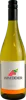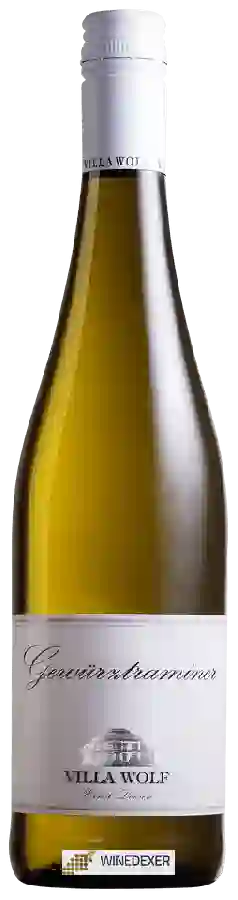
Winery Villa WolfGrauburgunder
 White wine



In the mouth this white wine is a .
This wine generally goes well with pork, cured meat or mushrooms.
Taste structure of the Grauburgunder from the Winery Villa Wolf
Light | Bold | |
Dry | Sweet | |
Soft | Acidic |
In the mouth the Grauburgunder of Winery Villa Wolf in the region of Pfalz is a .
Wine flavors and olphactive analysis



On the nose the Grauburgunder of Winery Villa Wolf in the region of Pfalz often reveals types of flavors of citrus, apples or minerality and sometimes also flavors of apricot, lemon or pear.
Food and wine pairings with Grauburgunder
Pairings that work perfectly with Grauburgunder


Original food and wine pairings with Grauburgunder

The Grauburgunder of Winery Villa Wolf matches generally quite well with dishes of pork, spicy food or mushrooms such as recipes of rice with sausage meat and tomatoes, rigatoni with courgettes and tomatoes or arctic char with baby vegetables.
Details and technical informations about Winery Villa Wolf's Grauburgunder.
Discover the grape variety: Belair
Intraspecific crossing between the barlinka and the Alphonse Lavallée obtained in 1974 in South Africa by E.P. Evans and P.J.L. Ellis. In the same country and with the same parents, other varieties were created such as happiness, la rochelle, ... . Belair is registered since 2012 in the Official Catalogue of table grape varieties list A2.
Last vintages of this wine
The best vintages of Grauburgunder from Winery Villa Wolf are 2013, 2016, 2017, 2015 and 2014.
Informations about the Winery Villa Wolf
The Winery Villa Wolf is one of of the world's greatest estates. It offers 50 wines for sale in the of Pfalz to come and discover on site or to buy online.

The wine region of Pfalz
Pfalz is a key wine producing region in western Germany, located between the Rhein/Rhine river and the low-lying Haardt mountain range (a natural continuation of the Alsatian Vosges). It covers a rectangle of land 45 miles (75km) Long and 15 miles (25km) wide. To the NorthLiesRheinhessen; to the South, the French border and Alsace. In terms of both quality and quantity, Pfalz is one of Germany's most important regions, and one which shows great promise for the future.
The word of the wine: Smoked
Qualifier of smells close to those of smoked food, characteristic, among other things, of the Sauvignon grape variety; hence the name of smoked white given to this variety.