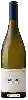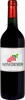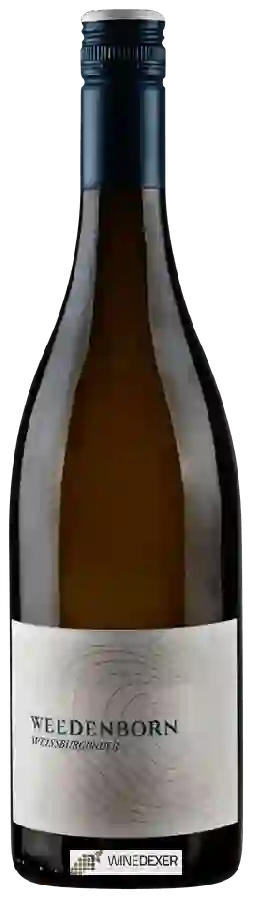
Winery WeedenbornWeissburgunder
 White wine



In the mouth this white wine is a powerful with a nice freshness.
This wine generally goes well with rich fish (salmon, tuna etc), shellfish or mild and soft cheese.
Taste structure of the Weissburgunder from the Winery Weedenborn
Light | Bold | |
Dry | Sweet | |
Soft | Acidic |
In the mouth the Weissburgunder of Winery Weedenborn in the region of Rheinhessen is a powerful with a nice freshness.
Wine flavors and olphactive analysis

Food and wine pairings with Weissburgunder
Pairings that work perfectly with Weissburgunder



Original food and wine pairings with Weissburgunder

The Weissburgunder of Winery Weedenborn matches generally quite well with dishes of rich fish (salmon, tuna etc), shellfish or mild and soft cheese such as recipes of baked sardines with garlic, panga curry or raclette with 8 cheeses.
Details and technical informations about Winery Weedenborn's Weissburgunder.
Discover the grape variety: Fogoneu
This grape variety is native to the Balearic Islands (Spain), more precisely to the island of Mayorque, and has been cultivated for a very long time. It is believed to be the result of a natural cross between the escursac or excursach and the mansés (or mancès) de capdell. DNA analyses show that the Fogoneu Mallorqui is not related to any other variety and that the Fogoneu is a direct descendant of the Callet. It can be found in Argentina, Spain and Italy, but is little known in France, although it should be interesting for the production of original rosé wines that are always very pleasant to drink.
Last vintages of this wine
The best vintages of Weissburgunder from Winery Weedenborn are 2014, 2018, 2013, 2015 and 0.
Informations about the Winery Weedenborn
The Winery Weedenborn is one of of the world's greatest estates. It offers 32 wines for sale in the of Rheinhessen to come and discover on site or to buy online.

The wine region of Rheinhessen
Rheinhessen is Germany's largest region for producing the quality wines of the Qualitätswein bestimmter Anbaugebiete (QbA) and Prädikatswein designations, with roughly 26,500 hectares (65,000 acres) of Vineyard">Vineyards as of 2014. Many of its most significant viticultural areas are favorably influenced by the Rhine river, which runs aLong its North and eastern borders. The Rhine, along with the Nahe river to the west and the Haardt mountains to its South, form a natural border. Rheinhessen covers an area south of Rheingau, north of Pfalz and east of Nahe, and is located within the Rhineland-Palatinate federal state.
The word of the wine: Chaptalization
The addition of sugar at the time of fermentation of the must, an ancient practice, but theorized by Jean-Antoine Chaptal at the dawn of the 19th century. The sugar is transformed into alcohol and allows the natural degree of the wine to be raised in a weak or cold year, or - more questionably - when the winegrower has a harvest that is too large to obtain good maturity.