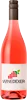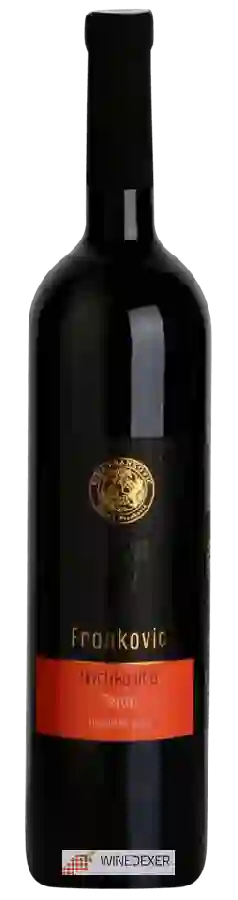
Winery Vina FrankovićTeran
 Red wine



In the mouth this red wine is a powerful with a nice balance between acidity and tannins.
This wine generally goes well with beef, game (deer, venison) or lamb.

Taste structure of the Teran from the Winery Vina Franković
Light | Bold | |
Smooth | Tannic | |
Dry | Sweet | |
Soft | Acidic |
In the mouth the Teran of Winery Vina Franković in the region of is a powerful with a nice balance between acidity and tannins.
Wine flavors and olphactive analysis


On the nose the Teran of Winery Vina Franković in the region of often reveals types of flavors of non oak, oak or spices and sometimes also flavors of red fruit.
Food and wine pairings with Teran
Pairings that work perfectly with Teran



Original food and wine pairings with Teran


The Teran of Winery Vina Franković matches generally quite well with dishes of beef, lamb or game (deer, venison) such as recipes of veal shank with mushrooms, lamb tagine with onions, purple olives and lemons... or mymy's golden apples (squash).
Details and technical informations about Winery Vina Franković's Teran.
Discover the grape variety: Terrano
Nervy, mineral reds with an intense violet-ruby robe, firm tannins and cutting acidity, showing aromas of red fruits (tart cherry, redcurrant), blackberry, wild herbs, iron and characteristic mineral notes of karst soils. Refreshing palate, saline finish. Star of Carso DOC (Friuli, Italy) and Kras (Slovenia) on the ferruginous red soils of the Adriatic plateau. Autochthonous Friulian-Slovenian variety, related to refosco.
Last vintages of this wine
The best vintages of Teran from Winery Vina Franković are 2014, 0, 2015
Informations about the Winery Vina Franković
The Winery Vina Franković is one of of the world's greatest estates. It offers 12 wines for sale in the of to come and discover on site or to buy online.

The wine region of
The word of the wine: Chaptalization
The addition of sugar at the time of fermentation of the must, an ancient practice, but theorized by Jean-Antoine Chaptal at the dawn of the 19th century. The sugar is transformed into alcohol and allows the natural degree of the wine to be raised in a weak or cold year, or - more questionably - when the winegrower has a harvest that is too large to obtain good maturity.