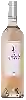
Winery Villa RossaBlanc Île de Beauté
 White wine
In the mouth this white wine is a .
This wine generally goes well with vegetarian, poultry or lean fish.
Taste structure of the Blanc Île de Beauté from the Winery Villa Rossa
Light | Bold | |
Dry | Sweet | |
Soft | Acidic |
In the mouth the Blanc Île de Beauté of Winery Villa Rossa in the region of Ile de Beaute is a .
Food and wine pairings with Blanc Île de Beauté
Pairings that work perfectly with Blanc Île de Beauté



Original food and wine pairings with Blanc Île de Beauté


The Blanc Île de Beauté of Winery Villa Rossa matches generally quite well with dishes of pasta, vegetarian or poultry such as recipes of the corsican soup, quiche without pastry, courgette and blue cheese or scandinavian beef balls.
Details and technical informations about Winery Villa Rossa's Blanc Île de Beauté.
Discover the grape variety: Esther
Interspecific crossing between the white Villard (Seyve-Villard 12375) and the magarcsi csemege obtained in 1969 in Hungary by Sandor Szegedi. This hybrid, most often used as a table grape, has been little multiplied and is still of great interest to amateur gardeners. It can be found in Hungary, Germany, Austria, Switzerland, Slovenia, ... completely unknown in France.
Informations about the Winery Villa Rossa
The Winery Villa Rossa is one of of the world's greatest estates. It offers 3 wines for sale in the of Ile de Beaute to come and discover on site or to buy online.

The wine region of Ile de Beaute
Ile de Beauté is the evocative PGI title given to wines that come from Corsica. The island is located in the Mediterranean Sea between the southeast coast of Provence and the west coast of Tuscany. Although the island is closer to Italy, it has been under French rule since 1764 and is one of the 27 regions of France. Corsica's Italian heritage is reflected in the island's wines, which are made primarily from Sangiovese (known here as Nielluccio) and Vermentino.
The word of the wine: Performance
Quantity of grapes harvested per hectare. In AOC, the average yield is limited on the proposal of the appellation syndicate, validated by the Inao. The use of high-performance plant material (especially clones) and better control of vine diseases have increased yields. This is not without consequences on the quality of the wines (dilution) and on the state of the market (too much wine). We must not over-simplify: low yields are not synonymous with quality, and it is often in years with generous harvests that we find the greatest vintages (1982 and 1986 in Bordeaux, 1996 in Champagne, 1990 and 2005 in Burgundy...).