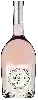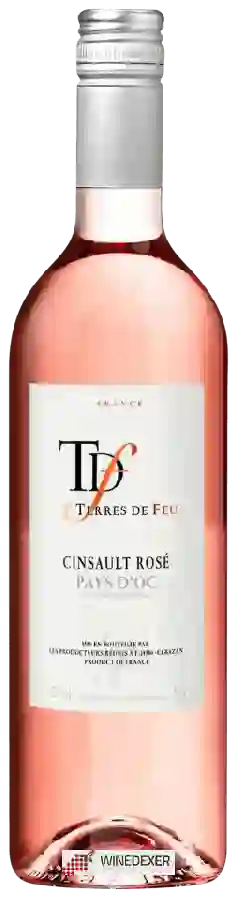
Winery Terres de FeuCinsault Rosé
 Pink wine



In the mouth this pink wine is a powerful with a nice freshness.
This wine generally goes well with vegetarian, appetizers and snacks or lean fish.
Taste structure of the Cinsault Rosé from the Winery Terres de Feu
Light | Bold | |
Dry | Sweet | |
Soft | Acidic |
In the mouth the Cinsault Rosé of Winery Terres de Feu in the region of Pays d'Oc is a powerful with a nice freshness.
Food and wine pairings with Cinsault Rosé
Pairings that work perfectly with Cinsault Rosé



Original food and wine pairings with Cinsault Rosé


The Cinsault Rosé of Winery Terres de Feu matches generally quite well with dishes of pasta, vegetarian or appetizers and snacks such as recipes of pasta à la forestière (chanterelles), quiche with leeks and fresh salmon from flo or tapenade.
Details and technical informations about Winery Terres de Feu's Cinsault Rosé.
Discover the grape variety: Rubi
Pink selection made in Brazil, following a natural coloured mutation of the italia, discovered in 1981 by San Giorgio Jonico. Since 24.08.2009, it is registered in the Official Catalogue of table grape varieties, list A1. In Italy, a more colourful mutation of the Rubi was discovered, called benitaka, which is more uniform in berry colour and ripens about a week earlier. The black brasil variety, which can be found in Brazil, is said to be a natural mutation of benitaka. Finally, Rubi should not be confused with ruby seedless, also a pink apyrene grape.
Last vintages of this wine
The best vintages of Cinsault Rosé from Winery Terres de Feu are 2016, 2017, 2019, 2018 and 2014.
Informations about the Winery Terres de Feu
The Winery Terres de Feu is one of of the world's greatest estates. It offers 6 wines for sale in the of Pays d'Oc to come and discover on site or to buy online.

The wine region of Pays d'Oc
Pays d'Oc is the PGI for red, white and rosé wines that are produced over a wide area of the southern coast of France. The PGI catchment area corresponds roughly to the Languedoc-roussillon">Languedoc-Roussillon wine region, one of the largest wine regions in France. The area covers all wines that are not produced under the strict laws that govern AOC-level appellations in the regions: among them, Corbières, Minervois and the Languedoc appellation itself. The Pays d'Oc PGI is arguably the most important in France, producing the majority of the country's PGI wines.
The word of the wine: Côte des Blancs
One of the most famous terroirs of the Champagne region, from Épernay to Vertus, mainly devoted to Chardonnay, hence its name. The villages of Chouilly, Cramant, Cuis, Mesnil-sur-Oger, Avize, etc., lying on the chalk, are in a way to Champagne what Meursault, Chablis and Puligny are to Burgundy.