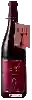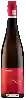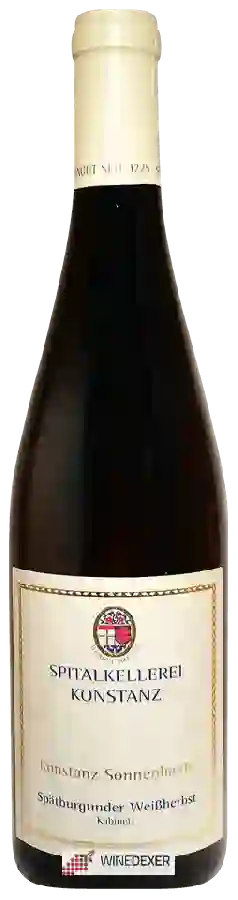
Winery Spitalkellerei KonstanzKonstanz Sonnenhalde Spätburgunder Weissherbst Kabinett
 Pink wine


This wine generally goes well with vegetarian
Food and wine pairings with Konstanz Sonnenhalde Spätburgunder Weissherbst Kabinett
Pairings that work perfectly with Konstanz Sonnenhalde Spätburgunder Weissherbst Kabinett

Original food and wine pairings with Konstanz Sonnenhalde Spätburgunder Weissherbst Kabinett
The Konstanz Sonnenhalde Spätburgunder Weissherbst Kabinett of Winery Spitalkellerei Konstanz matches generally quite well with dishes of vegetarian such as recipes of quiche with bacon and gruyère cheese.
Details and technical informations about Winery Spitalkellerei Konstanz's Konstanz Sonnenhalde Spätburgunder Weissherbst Kabinett.
Discover the grape variety: Canari
The Canary is rarely found in today's vineyards. Its origins are probably in the Pyrenees, precisely in the Ariège. Its repertoire of alternative appellations is vast. Boudalès from the Cévennes becomes folle noire in Fronton. It is also known as chalosse noire, ugne noire or canaril, and can be recognized by its early buds. The very productive vine shows remarkable vigour. Even the black rot does not get the better of this variety. The shoots are covered with foliage, the most exposed parts of which turn red in the autumn. When the grapes reach maturity, which occurs in the second late season, the Canari displays compact, section-shaped bunches of small to medium size. The fins are sometimes very crowded, gathering berries with characteristic colors. The bluish-black shell protects a very juicy flesh. A rather lightly coloured and ordinary wine emerges from the vinification of this variety.
Last vintages of this wine
The best vintages of Konstanz Sonnenhalde Spätburgunder Weissherbst Kabinett from Winery Spitalkellerei Konstanz are 2016, 0
Informations about the Winery Spitalkellerei Konstanz
The Winery Spitalkellerei Konstanz is one of of the world's greatest estates. It offers 32 wines for sale in the of Baden to come and discover on site or to buy online.

The wine region of Baden
German capital of Pinot Noir (Spätburgunder): silky, fine reds with notes of red fruits, cherry, undergrowth and sweet spices, melted tannins. Round Grauburgunder (Pinot Gris), lively Weissburgunder, supple Müller-Thurgau, mineral Riesling. Germany's 3rd region (15,000 ha) in Baden-Württemberg facing Alsace, one of the country's warmest climates, volcanic soils at the Kaiserstuhl. Cradle of modern great German reds, elegant and fine.
The word of the wine: Metis (grape variety)
A grape variety resulting from the crossing of two varieties of the same species. For example, pinotage (a South African grape variety) is the result of crossing pinot noir and cinsault.