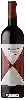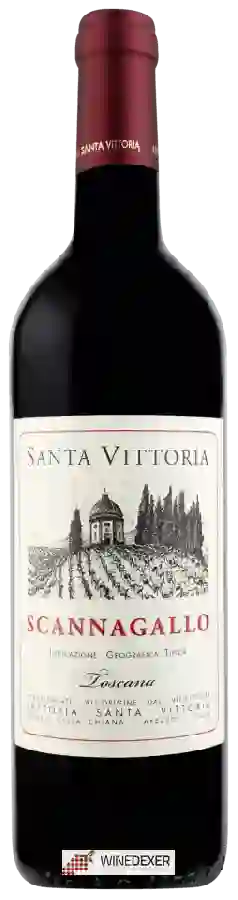
Winery Santa VittoriaScannagallo
 Red wine



This wine is a blend of 2 varietals which are the Cabernet-Sauvignon and the Sangiovese.
In the mouth this red wine is a powerful.
This wine generally goes well with poultry, beef or veal.
Taste structure of the Scannagallo from the Winery Santa Vittoria
Light | Bold | |
Smooth | Tannic | |
Dry | Sweet | |
Soft | Acidic |
In the mouth the Scannagallo of Winery Santa Vittoria in the region of Tuscany is a powerful.
Food and wine pairings with Scannagallo
Pairings that work perfectly with Scannagallo



Original food and wine pairings with Scannagallo


The Scannagallo of Winery Santa Vittoria matches generally quite well with dishes of beef, lamb or veal such as recipes of brazilian feijoada, oriental lamb skewers or sauté of veal with chorizo.
Details and technical informations about Winery Santa Vittoria's Scannagallo.
Discover the grape variety: Cabernet-Sauvignon
Cabernet-Sauvignon noir is a grape variety that originated in France (Bordeaux). It produces a variety of grape specially used for wine making. It is rare to find this grape to eat on our tables. This variety of grape is characterized by small bunches, and small grapes. Cabernet-Sauvignon noir can be found in many vineyards: South-West, Loire Valley, Languedoc & Roussillon, Cognac, Bordeaux, Armagnac, Rhone Valley, Provence & Corsica, Savoie & Bugey, Beaujolais.
Last vintages of this wine
The best vintages of Scannagallo from Winery Santa Vittoria are 2008, 2015, 2009, 2011 and 0.
Informations about the Winery Santa Vittoria
The Winery Santa Vittoria is one of of the world's greatest estates. It offers 16 wines for sale in the of Tuscany to come and discover on site or to buy online.

The wine region of Tuscany
Tuscany is one of the most famous and prolific wine regions in Europe. It is best known for its Dry red wines made from Sangiovese grapes, which dominate production. These include Chianti, Brunello di Montalcino and Vino Nobile di Montepulciano. The region's Vin Santo is also highly prized, as are its passito dessert wines, though these are produced in comparatively tiny quantities.
The word of the wine: Local wine
Table wine, but with the origin indicated. It corresponds to a particular legislation: the freedom to use grape varieties is greater than for the AOC, but the quality criteria such as the approval tastings can sometimes be more demanding. The legislation is still evolving, but for the moment there are three levels: regional (e.g. Vin de Pays d'Oc), departmental and local (e.g. Côtes de Thongue).